
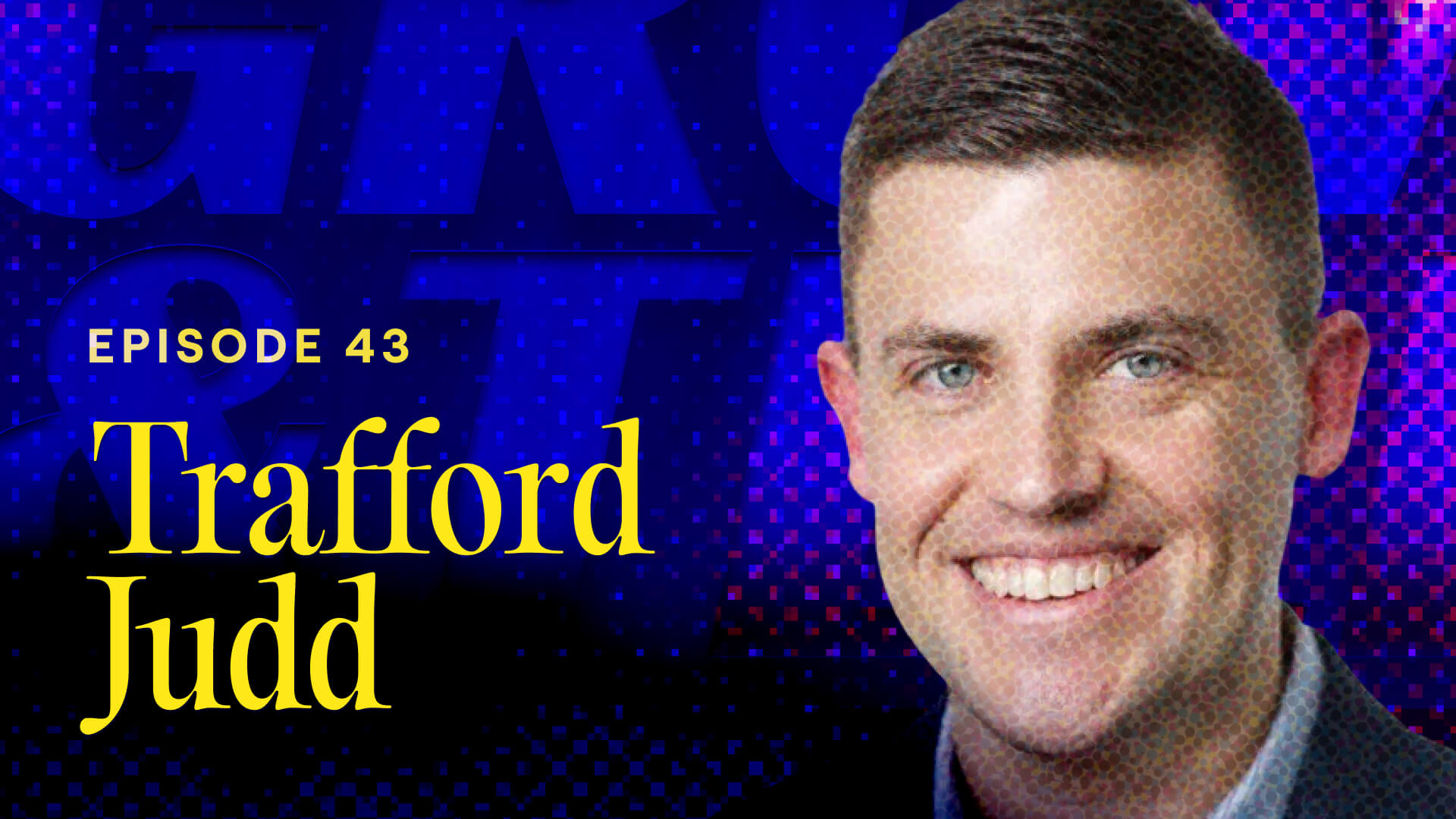
Why enablement is a behavior-change function, not a training department.
Trafford Judd has spent 20 years supporting sales organizations—but he didn't start in sales.
He started in HR, running talent and people functions before eventually joining LinkedIn, where he spent six-plus years in customer success and CS enablement roles.
By the time he joined Slack—on the exact day the Salesforce acquisition news broke—he had a mental model for enablement that most people in the function never develop: one built on behavior change, not training content.
That background has followed him everywhere. After Slack, he led global enablement at Asana. Then in early 2024, he joined Intenseye—an AI-powered workplace safety company—as a solo enablement hire with a mandate to build from scratch.
In less than two years, he's been promoted twice. His scope has expanded from enablement alone, to enablement plus RevOps, to now leading the full operations function: people, culture, talent, processes, and performance under one roof.
The progression isn't accidental. It reflects a thesis Trafford has been running his entire career—that enablement, done right, is one of the most strategic functions in a company.

Growth Bytes
Top takeaways:
- Enablement is a behavior change function—not a training department. Most companies never make that distinction, and it shows.
- Connect talent acquisition and enablement early. The closed loop on who ramps fast and why is more valuable than most orgs realize.
- Enable managers first, reps second. Salesforce and LinkedIn both do this well. Most startups skip it entirely.
- At a startup, build in this order: establish credibility → document what's working → onboarding baseline → sales process → competitive enablement.
- Buyers are overwhelmed and underserved by lazy AI-assisted selling. Companies that treat sales as a service function will win.
- Strong pilots are the best differentiation strategy for AI products that look alike on paper.
Enablement is a behavior change function, not a training department
Because Trafford came up through HR, his mental model for the function is fundamentally different.
"Enablement is really a behavior-change function. HR gave me a grounding that systems really fail when humans don't feel psychologically safe, and then secondly, supported by the environment they're in."
That framing shifts what enablement is actually trying to do.
It's not about delivering training content or running certifications. It's about diagnosing why people behave the way they do—and then changing the conditions that drive that behavior.
It's a perspective that's hard to develop if you've spent your whole career on the selling side, and it's shaped every role he's taken since.
The enablement-recruiting partnership most companies ignore
Ask Trafford which cross-functional relationship is most underrated in enablement, and he doesn't hesitate: talent acquisition.
"If you have strong alignment between your talent acquisition function and your enablement team, you have that closed loop of what's working, who is ramping quickly, and the types of profiles that are set to succeed."
Most companies don't have that loop. Recruiters hire against a profile. Enablement runs onboarding. Nobody connects the dots on whether the people coming in are actually the people who succeed.
Where it breaks down, Trafford says, is when HR builds competency models in a vacuum, enablement deploys a sales methodology with no input from the field, and managers are caught between two frameworks that don't talk to each other. Nothing sticks, and everyone eventually goes rogue.
In high-volume environments like LinkedIn and Slack—where onboarding cohorts of 20, 30, or even 100 people a month were normal—this alignment wasn't optional. You needed standardized performance metrics, consistent start dates, and a shared definition of what "good" looked like.
The best recruiters Trafford worked with didn't just post jobs and hand off candidates—they attended onboarding programs themselves, so they understood what sellers would be walking into and could recruit against it.
The cost of getting this wrong is higher than most companies account for. Even shaving 10% off attrition during onboarding has significant downstream effects on hiring costs, recruiter bandwidth, and long-term retention.
What Trafford learned from surviving the Salesforce-Slack acquisition
Trafford found out about the Salesforce acquisition of Slack on his last day at LinkedIn—a Friday afternoon notification on his phone, hours before he was set to start at Slack on Monday.
His new manager texted him almost immediately to confirm the job still existed. Don’t worry, it did. But the environment he'd signed up for had changed overnight.
"My goal of moving to Slack was to move to a smaller, more nimble organization. And I was like, man, it's part of Salesforce now. Am I making the right decision?"
He made the move anyway. What followed was six months in regulatory limbo while DOJ approval worked through—a strange window where enablement had wide latitude to build programs, much of it confidential M&A work designed to hit the ground the moment the deal closed.
When it did, the chaos was immediate: waves of Salesforce AEs migrating to Slack every week, two CRMs running in parallel, two laptops, two phones.
Salesforce sellers were being asked to migrate from Teams to Slack on day one—literally learning what a channel was and how to use it before they could sell it. Everything doubled. The work felt like constant triage.
But the experience sharpened skills that have defined Trafford's approach ever since. Ruthless prioritization. Tight frontline manager partnerships—because the only way to reduce seller thrash during integration is to have leaders absorbing it first. And deep exposure to how Salesforce operates at scale.
Value selling, customer-centric messaging, selling with an ecosystem in mind—Trafford pulled all of it into his own playbook. He also helped pioneer the virtual SKO format during this period, running a global sales kickoff that drew 90-plus percent attendance. The philosophy was clear even when the execution was hard.
"There's a sense of quality and polish in everything that Salesforce does. The marketing engine that has powered them taught me a lot about how I build my own programs and how I message things internally."
Enable managers first, reps second
One of the most consistent observations Trafford has made across LinkedIn, Salesforce, and his own work is that most companies treat manager enablement as a nice-to-have.
"In enablement, manager enablement is really the key unlock. But it's usually something companies don't invest in until they're at a certain size and scale."
Both LinkedIn and Salesforce had serious manager enablement programs. Most startups don't—they go direct to reps because it feels faster.
Trafford thinks that's backwards.
If you enable managers well, they become a multiplier on everything else you do.
If you skip them, you're running your programs through a broken distribution layer. Individual reps absorb training in isolation, without anyone reinforcing the behavior back on the floor.
His prescription for startups, especially: flip the script early. Enable reps through managers rather than trying to reach them directly.
"As this company starts to scale, I think really focusing on managers first is what I would do," he says. It's harder to set up, but the compounding effect is significant—and the cost of skipping it only grows as headcount climbs.
How to build enablement from scratch at a startup
When Trafford joined Intenseye in early 2024, there were roughly five AEs with different tenures, different skill levels, and no formal enablement infrastructure. It was a solo enablement role.
But his first instinct wasn't to build a program—it was to earn the right to build one.
"At a startup, you really need to be able to talk to the solution, the offering—really own a sales cycle as much as a seller would. Otherwise, your impact just won't be felt."
That meant listening before advising. Getting on calls. Understanding what was already working before trying to fix anything.
From there, his build sequence was deliberate:
- Start with onboarding as the baseline definition of what good looks like
- Layer in a sales process that reps actually believe in
- Add qualification elements as the process solidifies
- Tackle competitive enablement early—because it builds industry credibility fast and helps sellers understand the market.
The biggest early fix was discovery. Sellers were identifying use cases instead of uncovering problems—starting with the solution rather than the buyer's world.
In a market where many buyers aren't experienced tech purchasers, that reframe matters. Intenseye's prospects in manufacturing and warehousing are often willing to talk about their problems openly—but only if the conversation starts in their world, not the vendor's.
On tooling: Trafford recommends Notion before anything fancy.
Notion AI has become a forcing function—if a seller asks where a piece of content is, Trafford sends them to find it themselves. That's not laziness; it's training the behavior he wants to see.
The results have been visible enough that Trafford's scope expanded from solo enablement to leading RevOps, and then again to overseeing people, culture, and talent—the full operations stack. Two promotions in under two years at a 150-person company is its own kind of proof of concept.
It sucks to be a buyer right now—and that's an opportunity
Trafford is direct about the state of the market: "It really sucks to be a buyer right now."
Think about what a typical buyer experiences at any stage of a sales cycle:
- The volume of inbound messages on any given day.
- The first call where a rep has done a quick AI research pass and is serving up generic answers dressed up as personalization.
- The RFP process, where the buyer believes they can evaluate vendors better on their own.
The proliferation of AI-assisted selling tools has made this worse, not better. More outreach, less relevance. More content, less signal.
For Trafford, the response isn't to use less AI—it's to be more deliberate about what the buyer experience actually requires. The goal is to be a valuable partner to buyers, not another vendor adding to the noise.
"We've kind of lost sight of what sales actually is. It's a service function. It's helping people make a decision—and hopefully the right one."
This is especially acute for AI products, which face a compounding problem: two solutions can appear to check the same feature boxes yet perform very differently. "Buyers are used to comparing software features. If it checks the box, why am I paying twice as much?"
Communicating model quality, reliability, and accuracy—the things that actually matter—is a problem the industry hasn't solved yet.
The "don't tell me, show me" close
For AI products that look alike from the outside, the pitch meeting isn't where deals are won or lost. The proof of concept is.
Intenseye uses computer vision in physical environments—manufacturing plants, warehouses—which makes a traditional software POC more complex than a screen share.
Getting a physical pilot on-site requires coordination, hardware, and a longer timeline. But Trafford is clear that it's worth it.
"The ultimate differentiator is getting the pilot on site. Don't tell me, show me."
It's the same instinct that companies like Intercom have applied to AI products generally: surface the iceberg.
The product looks comparable to competitors until someone actually uses it on their own floor. Once they do, the quality gap becomes obvious. No slide deck required.
The on-site pilot isn't just a sales tactic—it's the kind of buyer experience Trafford has been advocating for throughout his career. High-effort, high-value, deeply consultative. The opposite of what most buyers are currently receiving.
Watch the full episode
Watch Alex and Trafford's full conversation on Grow & Tell, Dock's podcast for revenue leaders.


Related Revenue Lab Articles


%20(2).webp)

Templates for Sales, Onboarding,
Projects and Portals
Customize and share with clients


