
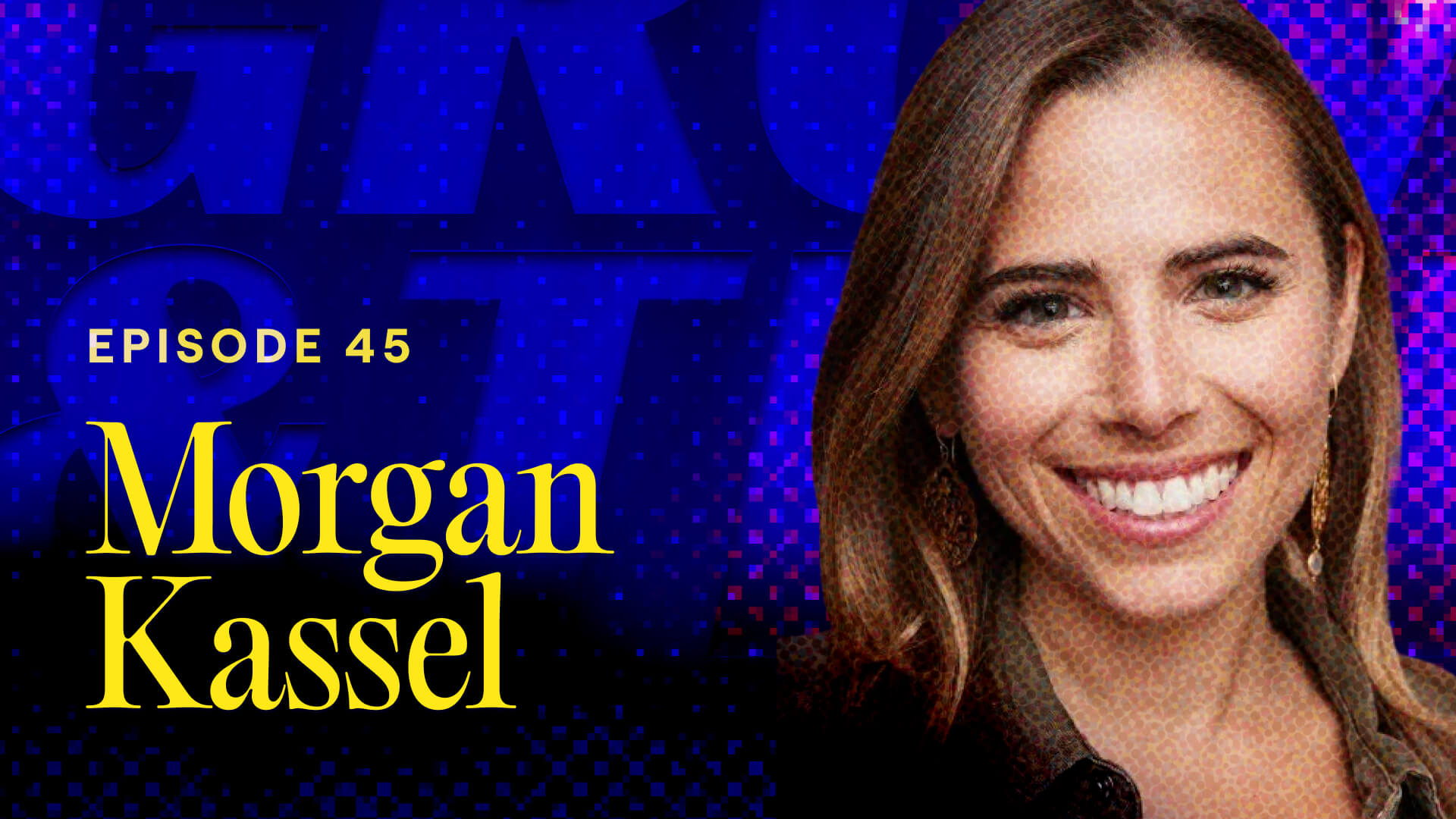
From value-selling fundamentals to SportsCenter clips to a CIA—how Morgan Kassel built enablement infrastructure as Vanta scaled to $4B
Morgan Kassel has a confession: when she started coaching sales reps on the side in 2020, she didn't know "sales enablement" was a job title.
She'd spent nearly a decade carrying a quota—ad sales at Martha Stewart Living, AE roles at Career Group and Caroo—and had developed a habit of gravitating toward new hires and junior reps, cheering louder for their wins than her own.
When her friend Eric Martin was standing up the sales team at a little compliance startup called Vanta, he asked if she'd lend a few hours a week to listen to calls and run role plays. She said yes immediately.
"I literally asked Eric when I joined Vanta full-time: 'So what's my title gonna be? Sales coach?'
And he's like, 'That's not a thing. It's called sales enablement manager.'"
Morgan joined Vanta as a contractor in late 2020 and came on full-time in December 2021—right as the company was beginning its climb from roughly $20M in ARR toward $100M+ today, scaling from around 200 employees to over 1,000.
Today, she's Vanta's Senior GTM Enablement Manager, part of a 13-person enablement team.
Here's what that program looks like.

Growth Bytes
Top takeaways:
- Start with value-based selling as the core curriculum. SDRs, AEs, and CSMs all learn how to value sell.
- The rep who controls the call is the one asking questions, not talking. Slow down, do the research before the call, and use questions to get prospects to articulate their own pain.
- Know enough to be dangerous, then team-sell the rest. Vanta doesn't expect AEs to become compliance experts, because their prospects can easily sniff out bluffing. Reps bring in subject matter experts when things get complex.
- Enablement’s role is to protect sellers’ time from other teams. Marketing, product, RevOps, and partners all want time with your sellers, and each believes their initiative is tier one.
- Use e-learning for knowledge transfer, live sessions for skill practice. Async e-learning is more efficient than pulling reps off the floor. Save live sessions for role plays, teachbacks, and scenario-based activities.
- Manager reinforcement is the variable most enablement programs underinvest in. The best training in the world won't stick if frontline managers aren't bought in before it happens—not after.
- Use AI for diagnosis, humans for coaching. Gong's AI can surface patterns and gaps at scale. What AI can't do is change behavior. That still requires human coaching.
The reactive-first phase: SportsCenter Top 10 and learning by doing
When Morgan joined Vanta full-time, the enablement program was, in her words, "very reactive versus proactive."
There was a weekly standing session where the agenda was driven by recent developments, such as a new competitor, a product update, or a recurring objection. No overarching strategy. No long-term curriculum. Just triage.
That sounds like a criticism, but it wasn't entirely a bug.
In the early days, Vanta was still relatively uncontested in its market. The sales motion was simpler, the team was smaller, and getting reps up to speed quickly mattered more than building infrastructure for a scale that hadn't arrived yet.
What Morgan brought from day one was a principle that has never changed: show, don't tell.
"Rather than me sitting there for 30 minutes telling AEs 'this is how we should respond to this objection,' I'm gonna go watch game tape and find an AE who is tackling that objection like a rock star and put them on SportsCenter Top 10."
Every enablement session opened—and still opens—with Gong clips of top performers handling whatever the theme of the week was. Great discovery questions. Clean objection handling. A well-run demo.
This has two clear benefits:
- Reps learn better from each other than from a trainer.
- Surfacing these moments publicly recognizes the right behaviors, makes them explicit, and gives other reps something specific and concrete to emulate.
A 90-second clip of a peer doing something brilliantly is worth more than a 30-minute slide deck on the same topic.
Scaling from "SOC in a box" to a segmented, specialized curriculum
The enablement program that worked for a 50-person sales team stopped working fast as Vanta's product and customer base expanded.
The original sales motion was essentially one product, one use case, one buyer—"SOC in a box," as Morgan puts it.
As Vanta added frameworks, moved upmarket into enterprise, opened offices in Dublin, London, and Sydney, and pushed past 100 quota-carrying reps, a one-size-fits-all program became untenable.
The solution was twofold: specialize by role, and specialize by segment. And to do that at scale, Morgan's team grew with it—from two people when she joined full-time to 13 today.
"I know a lot of people hearing that would probably be like, holy shit, that team is overstaffed," she says. "But we are really specialized because we've realized that the needs of the teams can vary greatly."
Their enablement team is specialized and segmented in three ways:
- Role-based: A CSM doesn't need to know how to prospect, but they do need deep expertise in value realization and expansion. An SDR needs pipeline gen fundamentals that an enterprise AE already has.
- Segment-based: A startup that just came out of Y Combinator has fundamentally different needs than a 2,000-person enterprise navigating a complex multi-framework compliance program. The value proposition is different, the buyer is different, and the skills required to sell effectively are different. Trying to deliver the same enablement to both groups doesn't just waste time—it signals to the reps that enablement doesn't understand their actual job.
- Geography-based: A CISO (Chief Information Security Officer) in EMEA is a different buyer than a CISO in the US, with different regulatory context, different communication norms, and different priorities. Reps in Dublin and Sydney need training that reflects those nuances, not a curriculum built entirely around North American enterprise sales.
But the specializations only work because they all build on a shared foundation.
The whole curriculum—every role, every segment—starts from a single set of core competencies anchored in value-based selling.
Morgan is emphatic that this foundation must be established deliberately, ideally in lockstep with sales leadership and the people team, before you layer anything else on top.
"Whether you're an SDR, solutions engineer, AE, account manager—whatever your role, it always is going to start with value-based selling. A CSM doesn't need to know how to prospect effectively. But value realization for the CSM is the biggest thing at Vanta."
Once you have that core defined, the curriculum can branch. Advanced negotiation for enterprise AEs who don't need the basics. Prospecting frameworks for new SDRs who do.
Onboarding at hyperscale: what broke, what stayed, what got added
Vanta's original onboarding program had a structural flaw that's easy to diagnose in hindsight: it mapped to the sales process, not the full sales job.
The logic was sensible: simulate the different types of calls a rep would have, run certifications to confirm readiness, and send them to market. What it missed was everything that happens before the first discovery call, and everything in between.
Vanta still runs discovery and demo certifications—either via a live mock call or by reviewing a real call afterward. Managers grade their reps against a scoring rubric developed jointly between enablement and sales leadership.
What has changed is the front end. Pipeline generation—prospecting, outbound, sequencing—is now a certified skill in onboarding, not something left to managers to reinforce ad hoc after the fact. You don't hit revenue goals without a healthy pipe, and "put pressure on reps to outbound" isn't an enablement program.
"Pipeline gen is not going anywhere. We don't hit our goals without outbounding. So we really built that in, giving them that fundamental framework to follow in the beginning. What are the tools you should be using? How should you be tiering and prioritizing your book of business? What modes of communication work well and why?"
The other major evolution is the mix of live versus asynchronous learning.
Vanta now uses e-learning for knowledge transfer—if the goal is to get information from point A (the enablement team) to point B (the rep's head), e-learning is more efficient than a live session.
Live sessions are reserved for skill practice: role-plays, teachbacks, and scenario-based activities that require reps to apply knowledge in real time.
Morgan says this model accommodates different learning styles without sacrificing the interactive elements that actually drive behavior change.
Recertification kicks in whenever a change is significant enough to warrant it. New standalone product? Certify. Updated pitch deck? Certify. New pricing and packaging model? Certify. The threshold is whether the change materially affects how reps should be selling, not just whether something new exists.
Protecting rep time: the goalie role nobody talks about
Morgan flagged a tension that most enablement leaders dance around.
"I'm gonna say something that my cross-functional coworkers would be horrified to hear, but a lot of what I do is goalie work. You've got marketing, rev ops, product, partners—all these different departments that want to get in front of the same sellers. And if you ask them all, every one of their initiatives is tier one."
(Most enablement leaders are too polite to admit this is half the job.)
The solution Vanta built is a formal intake process. Any cross-functional stakeholder who wants time with the sales team has to submit a request. That request gets mapped against the three priorities sales leadership has committed to for the quarter.
If it doesn't map, it goes back to the relevant sales leader with a specific question: Is this worth reprioritizing over something else, or does it wait?
Underpinning the system is a biweekly cross-functional meeting where marketing, product, RevOps, and partners review the calendar. A fixed number of hours can realistically be taken off the floor each quarter. Decisions about what fills those hours get made collaboratively, with a recommendation from enablement, and a final call from sales leadership.
The other discipline that keeps this honest is data. Early-stage enablement programs are often driven by the loudest voice in the room—a sales leader with a strong opinion about what their team needs, a rep who keeps raising the same concern, an exec who read something at a conference.
Morgan's relationship with RevOps has become the counterweight. Before anything becomes a priority, the question is whether the data supports it—is this actually a top close-loss reason, or is it one person's pet issue?
"When you're really early on at a company, everything gets surfaced up anecdotally," she says. "It's so important to always go back to what the data is telling you."
Competitive training that starts with Vanta, not the competition
Vanta has faced more than 40 copycat competitors since pioneering the automated compliance space. The competitive environment is brutal. And yet the philosophy behind Vanta's competitive enablement is almost contrarian: don't lead with competitors at all.
Vanta’s cleverly named CIA—Competitive Intelligence Agency—operates on a principle set by Vanta's founder, Christina Cacioppo, from the beginning: be competitor aware and customer obsessed.
In practice, that means competitive training starts with an exhaustive grounding in where Vanta wins on its own terms—most automated, most innovative, most trusted—and specifically which differentiators matter in which scenarios.
Speed-sensitive prospects get the automation story. Compliance-mature enterprises get a different angle. The differentiator that's right depends entirely on what the prospect cares about.
Only after reps know where Vanta shines do they learn how to position against specific competitors. And even then, the posture is offensive, not an attack.
"We want to get in there early, influencing what [prospects] should care about so that it gets on their checklist. They don't come to Vanta going, 'I want to work with a trusted proven market leader.' We have to get them to care about that early, versus talking shit and going feature by feature against competitors."
Rather than training reps to rebut a competitor's feature list, Vanta trains reps to ask questions that get prospects doing their own discovery. How does the other vendor define automation? What does their continuous monitoring actually look like?
Done right, it's less about competing and more about helping prospects figure out what they actually need.
Using AI to find the gaps humans then have to fix
Morgan's take on AI in enablement is straightforward: use it to save time and diagnose, not to coach.
Gong's auto-scoring, for instance, can analyze a handful of calls and surface patterns in rep behavior that would take a human manager hours to identify manually.
- Is this rep talking too much in discovery?
- Are they consistently missing a certain objection?
- Are they pitching before they've done adequate qualification?
AI can flag all of it. What it can't do is sit across from the rep and change the behavior. That still requires a human conversation.
Vanta also built a suite of Dust agents—AI bots trained on Vanta's internal knowledge base—to take repetitive research tasks off reps' plates.
Their “Compete GPT” can tell a rep the three differentiators to lean into against a specific competitor, given a specific prospect profile.
A pre-call research agent can pull a prospect's trust center status, relevant frameworks, and ICP details in roughly two minutes—work that previously required ten to fifteen minutes of scattered Googling.
The SDR team uses Hyperbound, an AI-powered cold-call simulator, to help new reps become comfortable with being put on the spot before they're in front of real prospects. The use case is narrow but well-suited to AI: Sellers benefit from more reps, and a bot can deliver those reps at zero social cost.
Morgan's read on the AI-versus-human question is clear-eyed. The SDRs heading to President's Club this year—more than 20 of them—are the ones taking the human approach: personalized LinkedIn outreach, face-to-face energy, genuine research. AI can assist with the preparation. It can't replicate the judgment.
Morgan Kassel is Senior GTM Enablement Manager at Vanta. Connect with her on LinkedIn.
Watch the full episode
Watch Alex and Morgan's full conversation on Grow & Tell, Dock's podcast for revenue leaders.


Related Revenue Lab Articles




Templates for Sales, Onboarding,
Projects and Portals
Customize and share with clients


