


%20(2).webp)
If you run sales enablement, you're probably experiencing AI-powered whiplash right now.
Every vendor claims their AI will "transform" your sales org. Every product launch promises to eliminate busy work and double your win rates. And yet, when you actually test these tools, half of them feel like the same old platform with a chatbot slapped on top.
It's exhausting. There’s pressure to be "using AI," but it's hard to separate what's genuinely useful from what's just hype dressed up as innovation.
The good news: some AI sales enablement tools are actually delivering.
Not by trying to replace your entire stack—but by solving specific, high-value problems: helping reps find the right content in seconds, coaching them in context during live deals, and guiding buyers through complex purchases without endless back-and-forth.
This guide covers the AI sales enablement tools worth evaluating. Some are full platforms. Others are focused point solutions. A few you've probably heard of. A few you might not have.
We'll break down what each tool does, where its AI actually helps, and how it fits into the broader enablement landscape—so you can figure out what's real and what's still catching up.
TL;DR: Our top picks
Major AI sales enablement tool categories
AI in sales enablement isn't a single tool—it's a collection of tools that solve different problems across the revenue cycle. Some are full-stack platforms trying to run your entire enablement operation. Others are focused point solutions that do one job exceptionally well.
If you're mapping the landscape, here are the high-traction AI use cases for sales enablement and what problems they're actually solving:
1. Buyer enablement and deal room platforms
The problem: Most deals involve multiple stakeholders, endless email threads, and scattered attachments that get lost or ignored. Reps spend hours manually assembling proposals, writing up personalized business cases, and chasing down who's actually reviewed the pricing.
How AI helps: Deal rooms consolidate everything—proposals, pricing, timelines, case studies—into a single shared workspace. AI personalizes content based on deal context, tracks stakeholder engagement, and surfaces when momentum stalls. The goal is to keep everyone aligned and give your champion what they need to sell internally.
Examples: Dock, Trumpet, Accord
2. Learning management and on-demand training
The problem: Training starts strong and fades fast. Reps sit through onboarding, pass the certification, and then revert to old habits by next quarter. When they need help mid-deal, the training portal feels too far away to bother with.
How AI helps: Instead of dumping everything into a single onboarding sprint, AI delivers bite-sized learning in the flow of work—surfacing the right playbook when a rep hits a specific deal stage or refreshing product knowledge when usage data shows it's slipping. The best systems tie training directly back to performance, so you can see what actually sticks.
Examples: Spekit, Mindtickle, Dock
3. Customer relationship management (CRM) systems
The problem: Your CRM is supposed to be the source of truth, but it's only as smart as the data inside it. Most reps hate data entry, which means your pipeline insights are based on incomplete or outdated information.
How AI helps: AI layers on top of your CRM to automate activity capture, enrich contact data, surface deal risks, and feed predictive insights into your connected tools. The stronger your CRM data, the smarter every other AI system becomes—this is the foundation the rest of your stack depends on.
Examples: Salesforce Sales Cloud, HubSpot Sales Hub
4. Conversation intelligence and AI coaching
The problem: Traditional coaching happens too late—after the deal is lost or the quarter is over. Managers don't have time to listen to every call, so they coach blind, relying on CRM notes and gut feel rather than what actually happened on the call.
How AI helps: Conversation intelligence tools record and analyze sales calls in real time, flagging key moments, tracking talk ratios, and summarizing next steps. Managers can coach on actual behavior patterns while deals are still live, and reps get immediate feedback on what's working (or not) in their pitch. AI role-play takes this a step further—letting reps practice objection handling, discovery questions, and product messaging against a simulated buyer before they're on a live call. The result: reps show up to conversations with more confidence and fewer first-rep mistakes.
Examples: Gong, Chorus, Fathom
5. Forecasting, scoring, and analytics
The problem: Pipeline reviews feel like creative writing exercises. Reps are optimistic. Managers adjust based on intuition. And by the time you realize a deal was never real, it's too late to make up the gap.
How AI helps: AI analyzes engagement trends, rep activity, and historical win patterns to separate healthy deals from wishful thinking. For enablement leaders, this means you can finally tie content usage and training metrics back to actual pipeline health—and prove what's working and what's not.
Examples: Clari, People.ai, BoostUp
6. Specialized point solutions
The problem: Not every team needs a full platform. Sometimes you just need one specific thing done really well—like auto-tagging your content library, generating presentation decks faster, or cleaning up CRM data.
How AI helps: Point solutions plug into your existing stack and solve very specific bottlenecks without forcing a platform migration. These tools tend to be faster to implement and easier to justify because they solve one painful problem extremely well.
Examples: Clay for data enrichment, Jasper for content generation, Lavender for email coaching
Where should you start?
As you're going through all these categories, you may be thinking: "Do we actually need to be using AI, or is this just the latest shiny object we're supposed to care about?"
Fair question. The hype cycle is real, and most tools aren't honest about where their AI actually works versus where it's still catching up. But when AI solves a real problem, the results are hard to ignore.
According to Gartner, sellers who use AI tools effectively are 3.7x more likely to meet quota than those who don't. And MarketsandMarkets research found that companies using AI-driven revenue intelligence systems are seeing a 23% improvement in quota attainment, with forecast accuracy rising from 65% to 95%.
So where should you start?
Each category tackles a different piece of the enablement puzzle. The established legacy players—Seismic and Highspot—have built full ecosystems that span multiple categories, layering AI onto mature platforms. Meanwhile, a new wave of AI-native tools like Dock is emerging, built from the ground up with AI at the core rather than retrofitted on top.
The market is splitting into purpose-built strengths. Seismic leans into content governance and enterprise scale. Highspot focuses on guided selling and playbook execution. Dock leads in buyer collaboration and AI-powered deal rooms.
The key is understanding which problems you need solved first—then building a stack where the tools actually talk to each other. So let’s get into the tools.
1. Dock
Dock is an AI-powered revenue enablement platform built to align sellers and buyers throughout the entire deal cycle—from first call through renewal.
The platform combines three core capabilities: collaborative deal rooms where buyers and sellers work together, an AI-powered content library that surfaces the right assets at the right time, and a learning layer that trains reps in the flow of work.
Dock AI connects your CRM, call transcripts, content library, and buyer engagement data to deliver real-time guidance across your revenue team—no custom workflows, prompt engineering, or ChatGPT bolt-ons required.
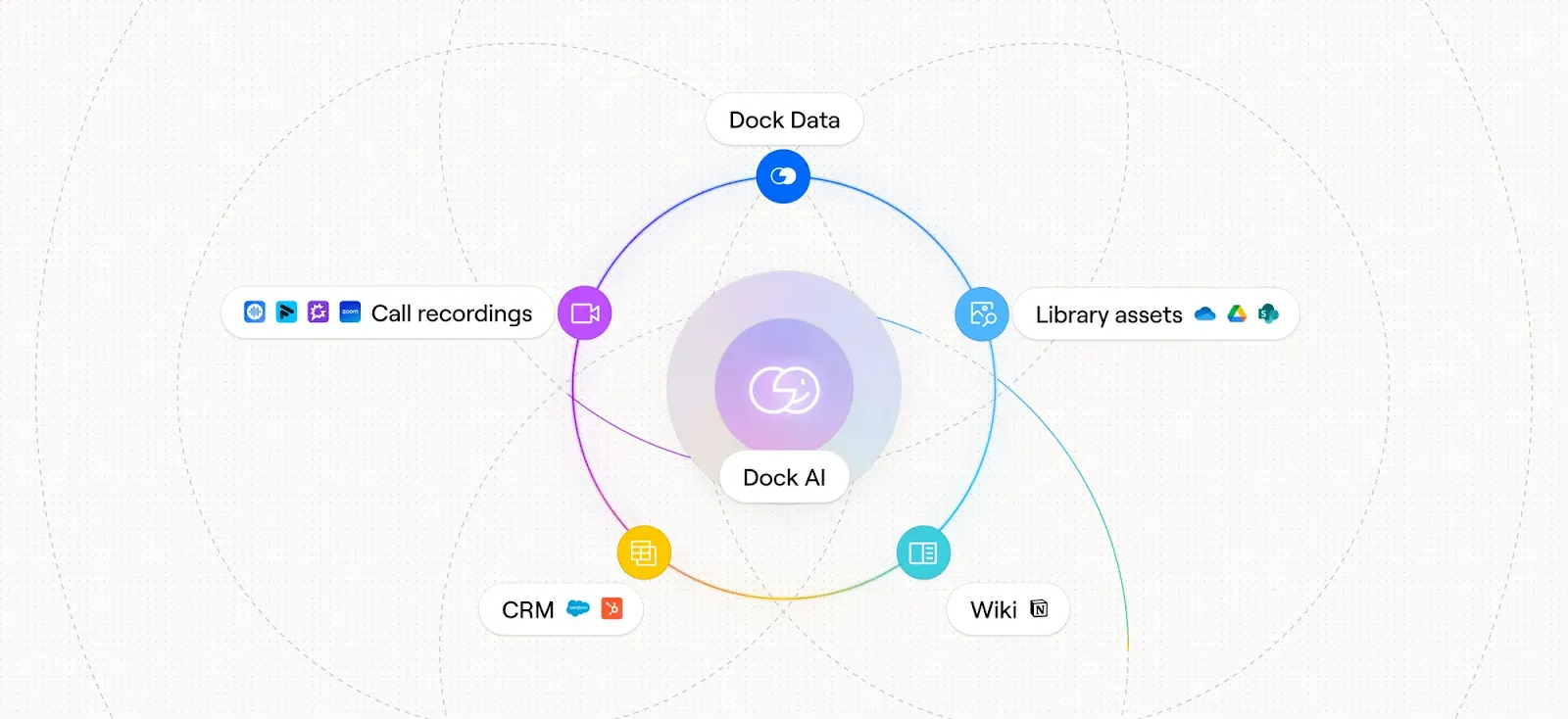
Key AI features for sales enablement
- AI-powered sales rooms: Dynamic deal rooms that evolve through the entire sales process—from discovery to onboarding to renewal. Every stakeholder gets a shared source of truth with everything they need: proposals, pricing, timelines, mutual action plans, and next steps.
- AI-powered Content Library: Syncs with Google Drive and SharePoint, automatically tags and organizes assets, and ensures sellers always surface the latest, approved content—no more hunting through folders or using outdated decks.
- AI Enablement Agent: A real-time assistant that answers reps' questions instantly—from "Which deck should I use for a technical buyer?" to "What's the next step for this deal?" Think of it as an always-on enablement team member.
- Custom AI agents: Beyond Dock's prebuilt agents, teams build their own—custom instructions, connected sources (workspaces, library, playbooks, courses, call recordings, CRM, Notion, Confluence), and a fixed output format—to automate recurring GTM tasks, kept private or shared company-wide.
- MCP interoperability: Dock MCP connects to Claude, ChatGPT, and Gemini, so reps can search workspaces, pull account context, and create content from the AI assistant they already use—with each user's Dock permissions enforced.
- Engagement and buyer analytics: Tracks which stakeholders engage with content, how often, and when deal momentum stalls. These buyer signals feed directly back into your CRM, so you know what's working and where deals are at risk.
- Two-way CRM syncing: Deep integrations with Salesforce and HubSpot that sync deal data and buyer activity both ways, keeping your CRM current without manual data entry.
- Sales LMS: Dock's learning management system lets you build interactive courses, quizzes, and learning pathways for onboarding, ongoing enablement, and customer education. And everything in your LMS feeds into Dock AI.
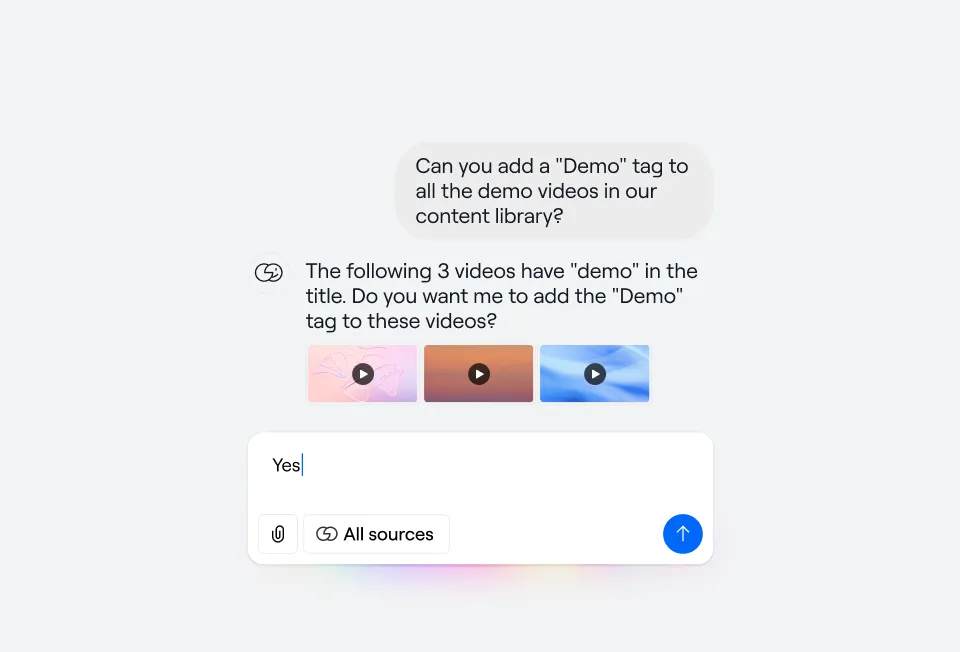
How it all ties together
The power of Dock lies in how AI Documents and buyer workspaces connect.
Dock AI generates a personalized business case or proposal in seconds, pulling from your CRM and call transcripts. Then you drop that content directly into the same buyer workspace where your champion is already collaborating. Now they have one place with everything they need to sell internally: pricing, ROI calculations, timelines, and next steps.
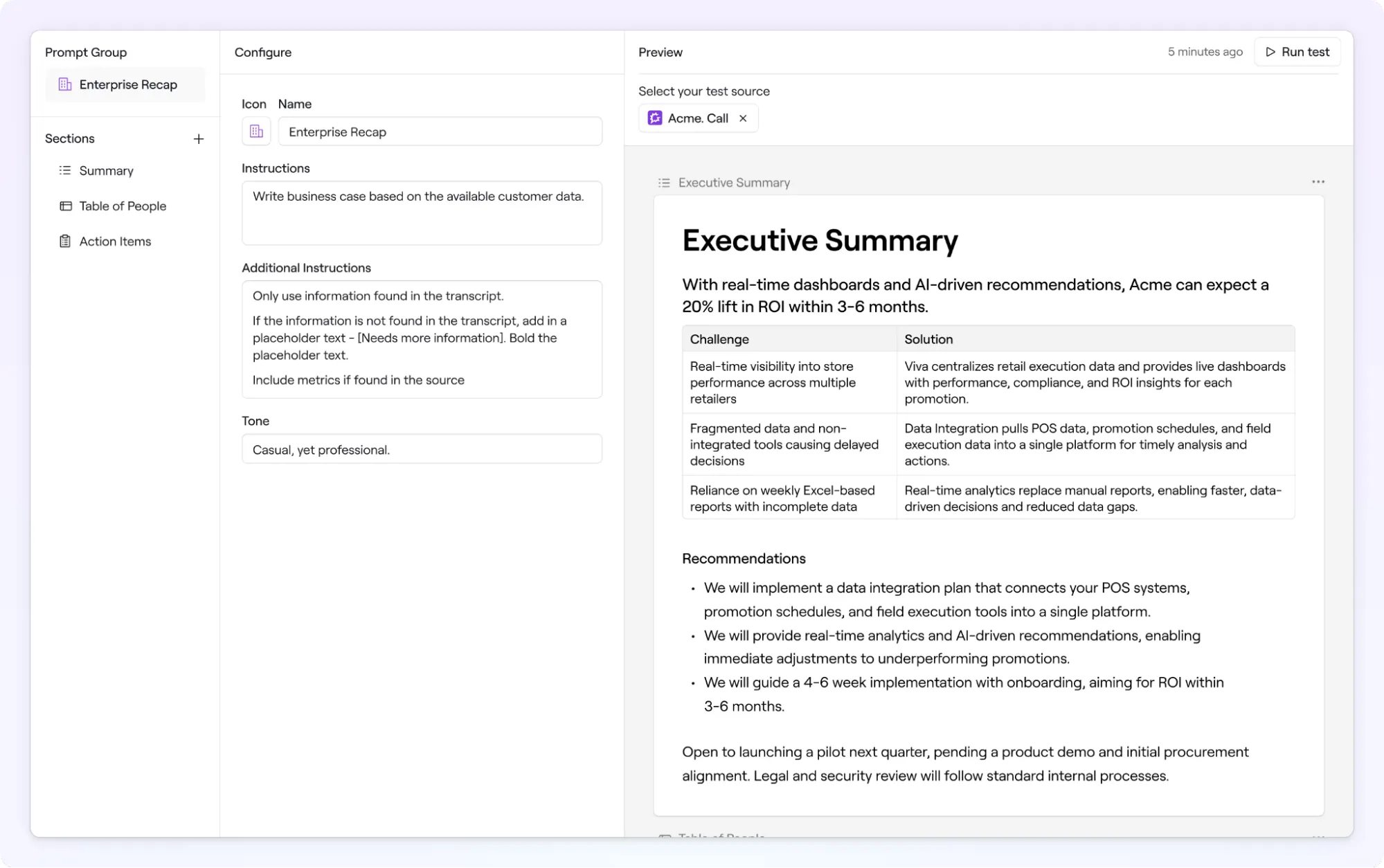
Dock pricing
Dock is free to try for small teams, with paid plans starting at $350/month for 5 users (Standard) and $1,000/month for 10 users (Premium). Contact us for enterprise pricing.
While Dock leads the AI-native wave, several incumbents are layering AI into established enablement ecosystems. That leads us to…
2. Seismic
Seismic is the enterprise heavyweight in sales enablement—a mature, all-in-one platform for content management, training, and analytics at scale.
The "Enablement Cloud" ties together content delivery, learning management, and buyer engagement under one system. In recent years, Seismic added Aura, its AI engine for guided selling and content discovery, layering AI capabilities onto its established platform architecture.
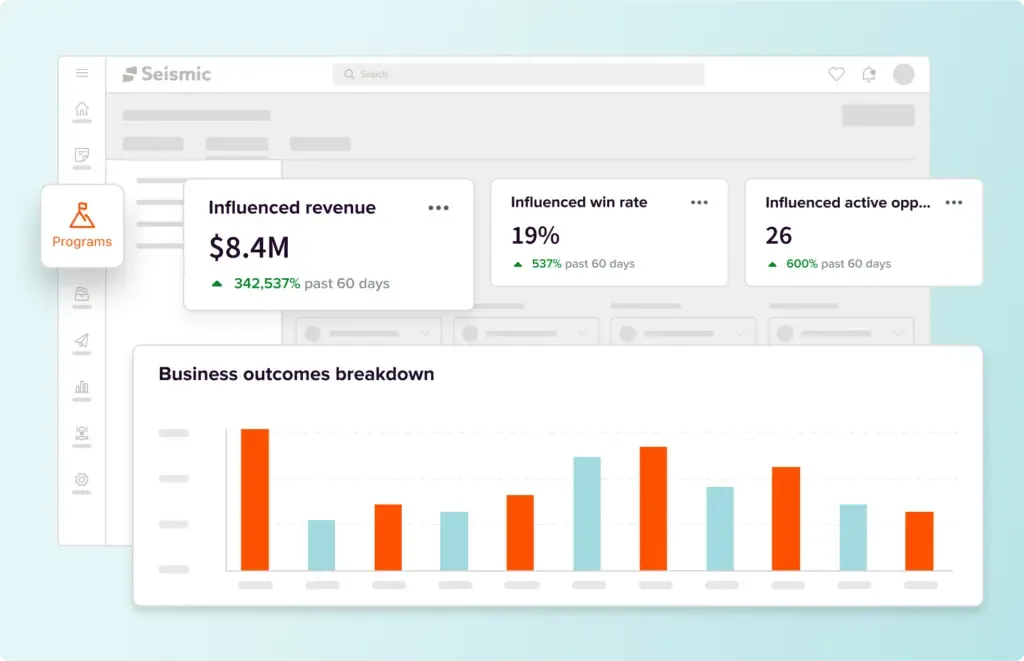
Key AI features for sales enablement
- Aura Copilot and guided selling: An AI assistant that answers reps' questions, recommends content based on deal context, and helps with search across Seismic's content library.
- Generative content and auto-tagging: AI generates playbooks, templates, and micro-lessons, then automatically tags assets for discoverability so reps can find what they need without manual organization.
- Enablement intelligence and analytics: AI-powered dashboards surface content performance insights, user behavior trends, and recommendations to close content gaps or adjust training programs.
- AI-driven coaching and readiness: Automated scoring of training completions and role-play recordings, personalized coaching paths based on skill gaps, and recommendations for where reps need additional practice.
- Seismic Programs: A planning and execution layer where enablement teams launch initiatives, monitor adoption across the organization, and tie enablement activities back to revenue outcomes—with AI helping optimize performance over time.
What to know
Seismic's AI capabilities sit on top of a massive enterprise stack—powerful for large organizations with complex governance needs, but often slower to configure and evolve compared to AI-native platforms. Best suited for global enterprises that prioritize content control, compliance, and structured rollouts over speed and flexibility.
Seismic pricing
Seismic doesn't list pricing publicly. Based on our experience and customer feedback on both platforms, annual contracts typically start at around $50,000 and often exceed $100,000 for larger teams.
3. Highspot
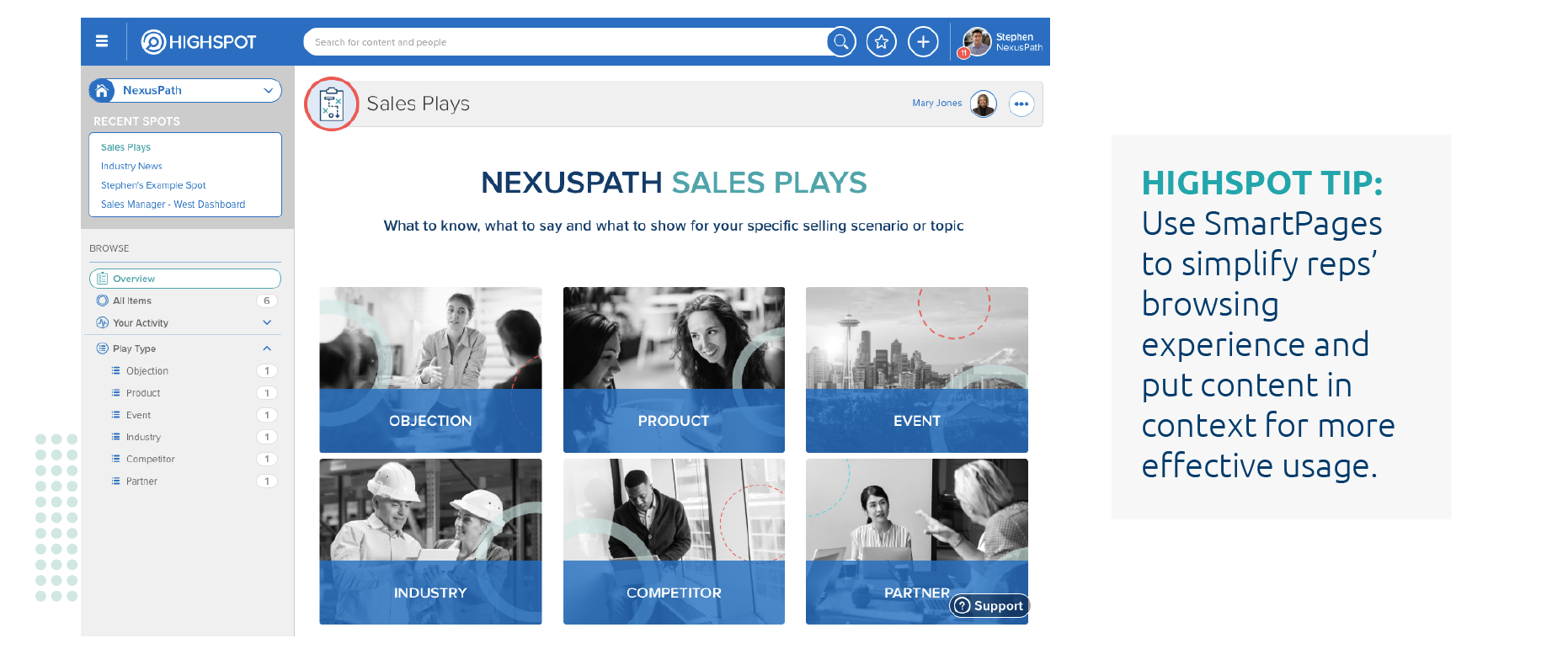
Highspot is one of the most widely adopted enablement platforms, built for sales organizations that want structure and consistency at scale.
The platform's foundation is guided selling through "SmartPages"—structured playbooks that help reps follow consistent sales motions across different deal stages and buyer personas. Highspot has layered AI capabilities on top of this framework, adding smarter search, predictive content recommendations, and conversation analysis.
Key AI features for sales enablement
- SmartPage playbooks with AI recommendations: Dynamic playbooks that adapt based on deal stage and buyer persona, with AI suggesting relevant content, talk tracks, and next steps as reps progress through the sales motion.
- AI search and content recommendations: Natural language search that surfaces relevant materials from Highspot's content library, plus predictive recommendations based on what's worked in similar deals.
- Scorecards and coaching intelligence: AI analyzes sales call recordings and rep performance trends to identify coaching opportunities, flag skill gaps, and surface which behaviors correlate with wins.
- Content performance analytics: Tracks how buyers engage with shared materials and correlates content usage with deal outcomes, helping enablement teams identify what's actually moving deals forward.
What to know
Like Seismic, Highspot's AI features are built on top of a mature, well-established platform. It’s a strong choice for teams that prioritize guided selling frameworks and structured playbook execution, though the platform's focus on internal rep enablement means it offers fewer buyer-facing collaboration tools.
Highspot pricing
Highspot offers custom pricing based on company size and deployment scope, typically targeting enterprise buyers. On AWS Marketplace, plans start at approximately $66 per user per month ($792 per user annually). Minimum contracts generally start around $50,000 per year.
4. Showpad
Showpad is another established enterprise sales enablement platform, competing directly with Seismic and Highspot as one of the "Big 3" incumbents. The company recently merged with Bigtincan (October 2025) under Vector Capital to create what they're positioning as an "AI-native revenue effectiveness platform."
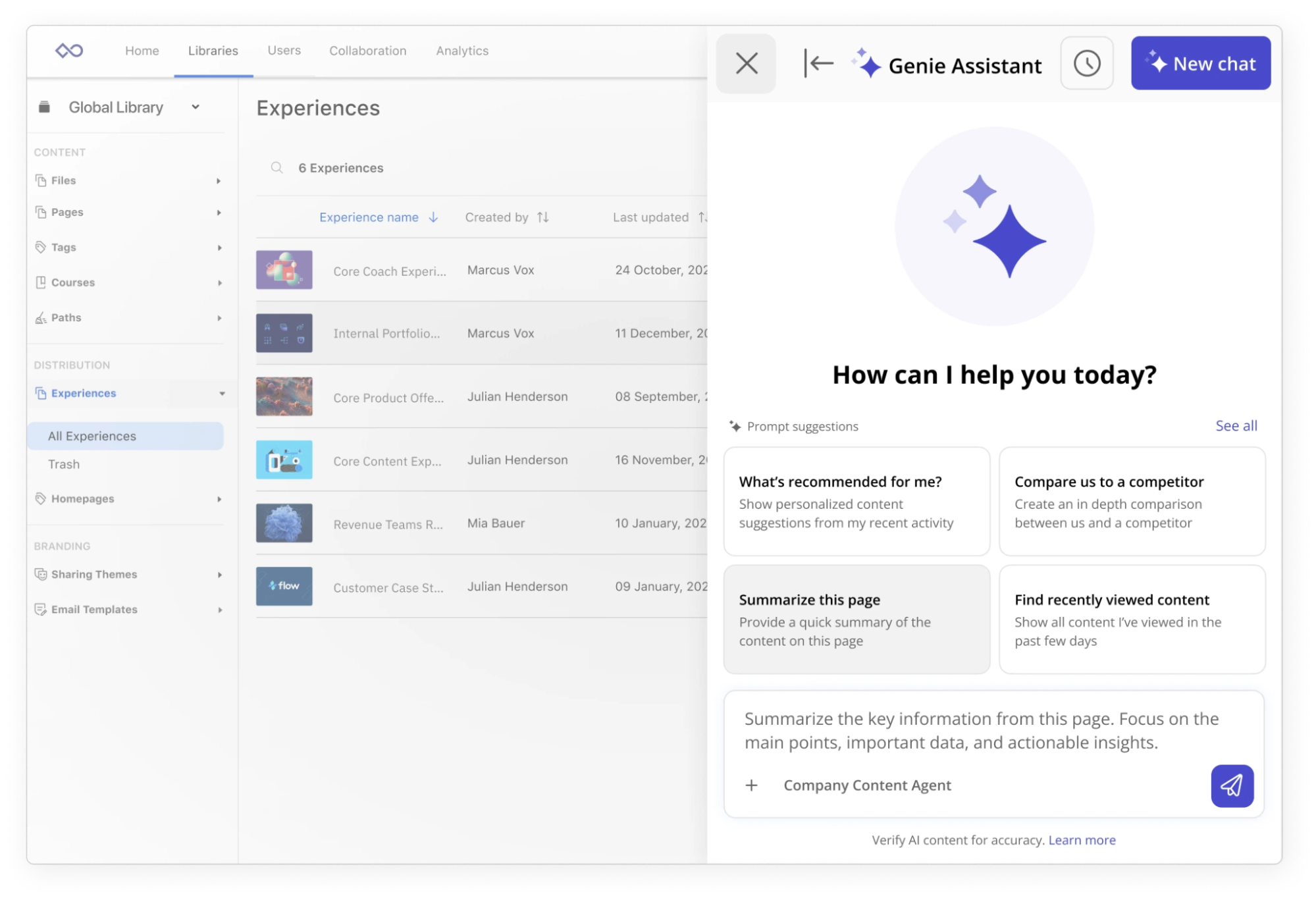
Showpad's strength has historically been in content management and sales readiness for field sales teams. In recent years, the platform has added AI capabilities through "Showpad Assist," its AI-powered sales assistant, and integrated generative AI features using Anthropic's Claude models via Amazon Bedrock.
Key AI features for sales enablement
- Showpad Assist: An AI-powered sales assistant that provides real-time insights, content suggestions, and talking points tailored to each customer interaction. Helps account managers prioritize opportunities and prepare for meetings with customer-specific intelligence.
- AI content summaries: Generates summaries of sales assets, allowing reps to quickly understand key learnings from documents during buyer conversations without reading entire files.
- PitchAI: AI-driven content recommendations that help reps find and deliver the right materials based on buyer persona, deal stage, and conversation context.
- Question-based learning dashboards: AI-powered analytics that connect enablement activities to business outcomes, showing how training programs influence time-to-first-deal, revenue impact, and rep performance.
- AI-powered training: Personalized learning recommendations and performance insights that adapt to individual rep needs and skill gaps.
What to know
Like Seismic and Highspot, Showpad's AI features are layered onto an existing platform architecture rather than built AI-first from the ground up. The platform remains strong for manufacturing, healthcare, and technology companies with large field sales teams who need structured content management and training programs.
Showpad's recent merger with Bigtincan (October 2025) under private equity firm Vector Capital creates both opportunity and uncertainty. While the combined entity has greater scale and resources, PE-backed mergers typically introduce integration challenges that can slow product development and innovation. Enablement leaders evaluating Showpad should consider the roadmap implications, which could take 12-18 months to stabilize post-merger—a lifetime in AI world.
Showpad pricing
Showpad uses custom enterprise pricing and doesn't publish rates publicly. Based on marketplace data, annual contracts typically range from $60,000–$100,000 depending on team size, modules, and integrations—roughly $30–$50 per user per month.
5. Mindtickle
Mindtickle positions itself as a revenue readiness platform that combines training, coaching, conversation intelligence, and content management under one roof.
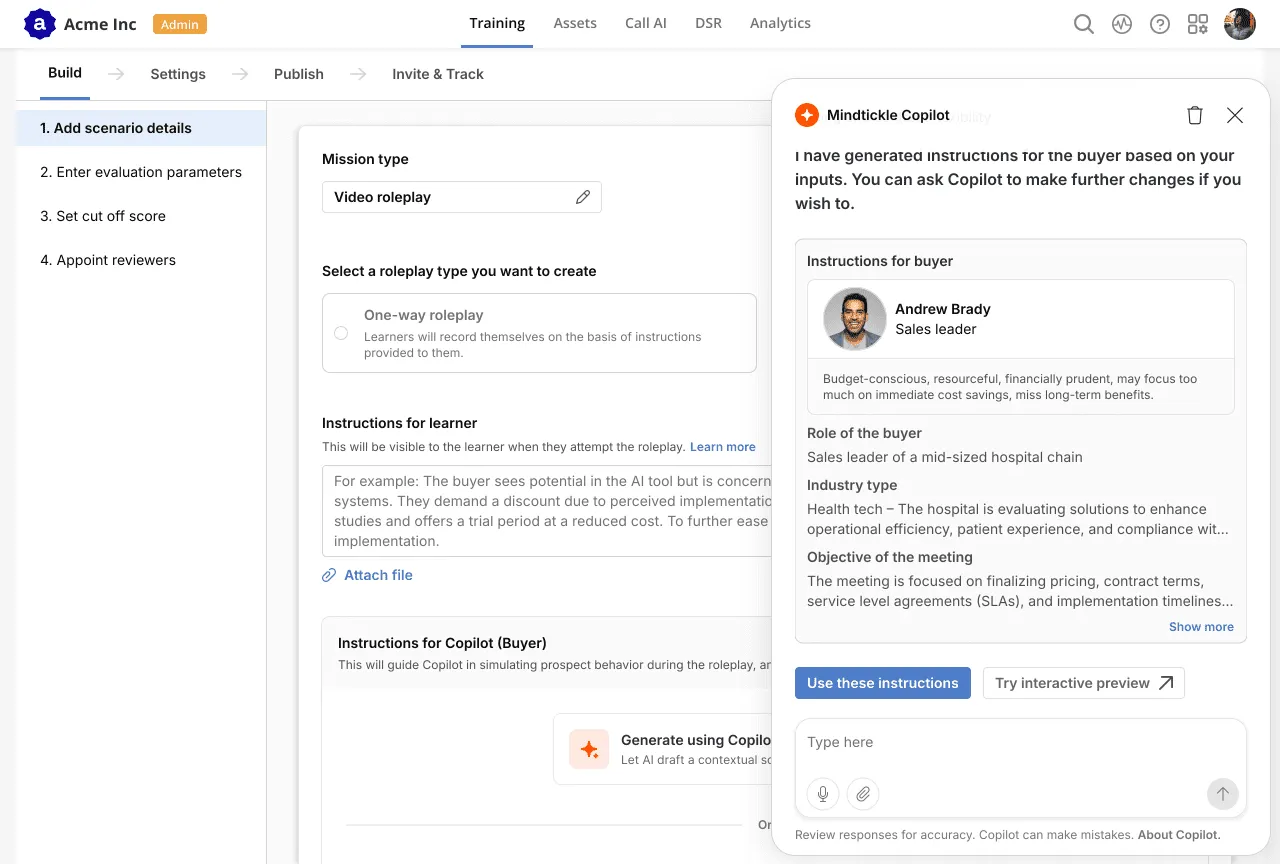
The platform's focus is on "readiness"—ensuring reps have the skills, knowledge, and practice they need before they get on calls. Mindtickle has recently added AI across the platform, with role-specific features for sellers, managers, and enablement teams.
Key AI features for sales enablement
- Call/Deal AI: Capture and score buyer interactions, identify signals, topics, themes, and deal risks.
- AI copilot: Role-based assistance to help reps prep for calls, generate follow-ups, suggest content, and automate tasks.
- AI role-plays and practice: Generate pitch scenarios and grade submissions automatically to scale coaching.
- Enablement analytics and readiness insights: Dashboards that correlate training with revenue outcomes, highlight skill gaps, and measure program impact.
- Content and training automation: Prompt-based content generation, just-in-time training, and dynamic content alignment to close deals.
What to know
Mindtickle excels at structured readiness programs—onboarding paths, certification tracking, and skills assessments. Like other established platforms, it layers AI capabilities on top of a mature system, which means deep functionality, but a lot of complexity in configuration and adoption.
Mindtickle pricing
Mindtickle does not publish public pricing, but figures to be in the same pricing tier as Seismic and Highspot. According to Vendr, the average contract value is approximately $92,000 annually.
6. Mutiny
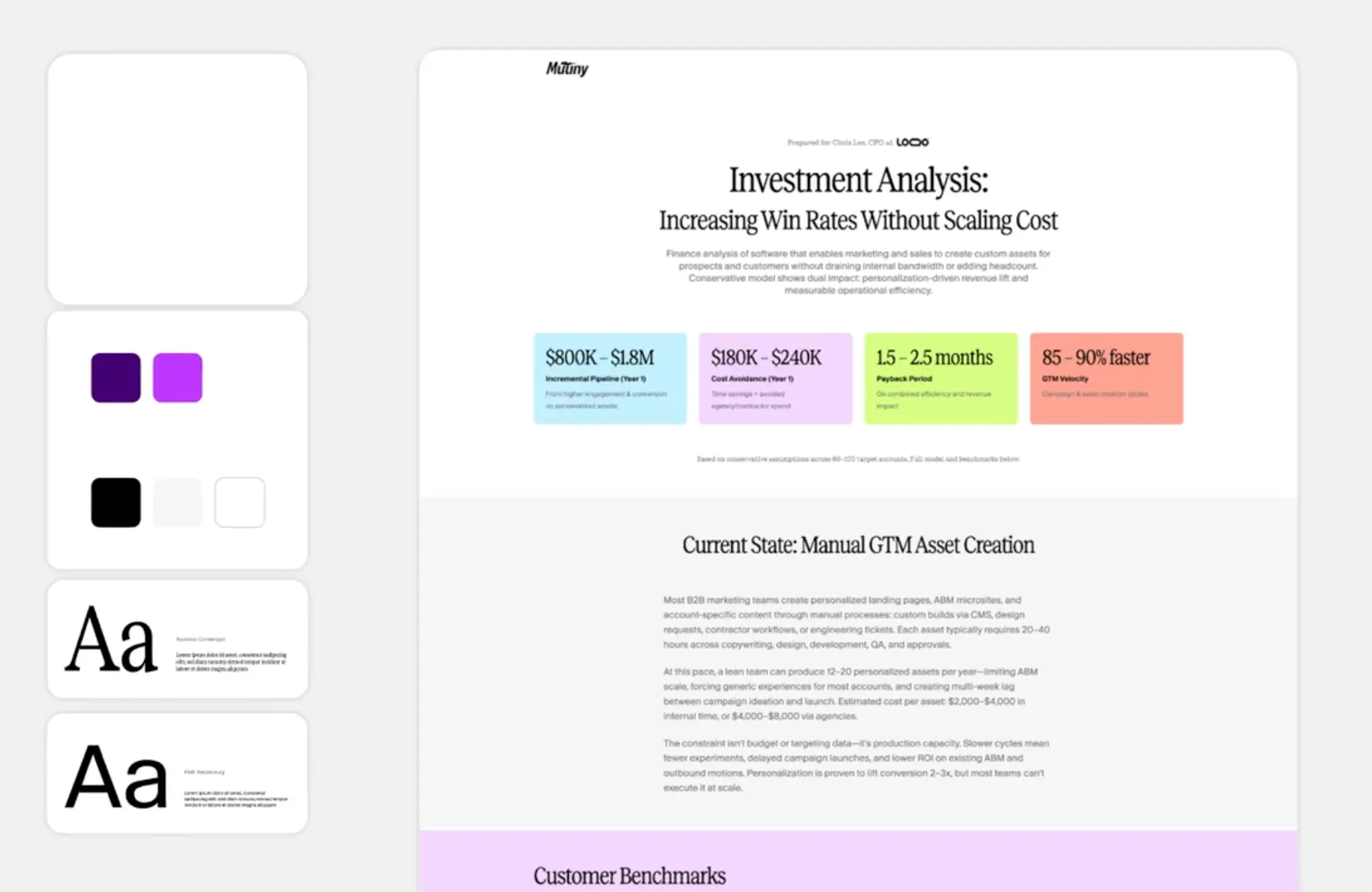
Mutiny is an AI-native content generation tool for go-to-market teams. Instead of a library reps search through, it generates customer-facing assets—business cases, pitch decks, pricing proposals, competitive comparisons, and deal rooms—from scratch for each account, pulling from CRM data, call transcripts, and your playbooks.
It started as an account-based marketing personalization tool and rebuilt agent-first in its April 2026 relaunch, so generation is the core of the product rather than a feature added on top. Reps prompt the agent directly, and it keeps each account's context so the next asset lands closer.
Key AI features for sales enablement
- Agentic content generation: Creates net-new, account-specific assets—deal rooms, business cases, decks, pricing proposals, competitive comparisons—in minutes, generated per deal rather than pulled from a shelf.
- Build-your-own agents: Reps and marketers build their own agents and routines to automate recurring GTM work like follow-ups and ABM campaign assets.
- Account memory: Holds context across accounts and deals, so generated assets get more tailored as you go.
- Brand guardrails: Extracts colors, fonts, and logos from your site so self-served content stays on-brand without a design review.
- MCP interoperability: Plugs into Claude and other MCP-compatible tools, so assets and skills flow into the AI assistant your team already uses.
What to know
Mutiny is strongest for ABM and demand-gen teams that need account-specific content at scale—personalized landing pages, 1:1 campaign assets, and deal collateral—without routing every request through design or a marketing queue. Because it's AI-native and self-serve, reps can use it on day one. The tradeoff is scope: it generates assets but doesn't manage a content library, run training, or handle post-sale, so teams wanting a true CMS/LMS should look elsewhere.
Mutiny pricing
Mutiny offers Free and Business tiers, with Enterprise starting around $30,000/year.
7. Spekit
Spekit is built around the concept of "just-in-time enablement" (they even trademarked the term)—delivering training, content, and answers directly inside the tools reps already use, like Salesforce, Gmail, or Gong.
The platform's AI "Sidekick" surfaces contextual guidance without requiring reps to leave their browser tab or search through a separate knowledge base. The idea is to reduce friction by meeting sellers where they already are.
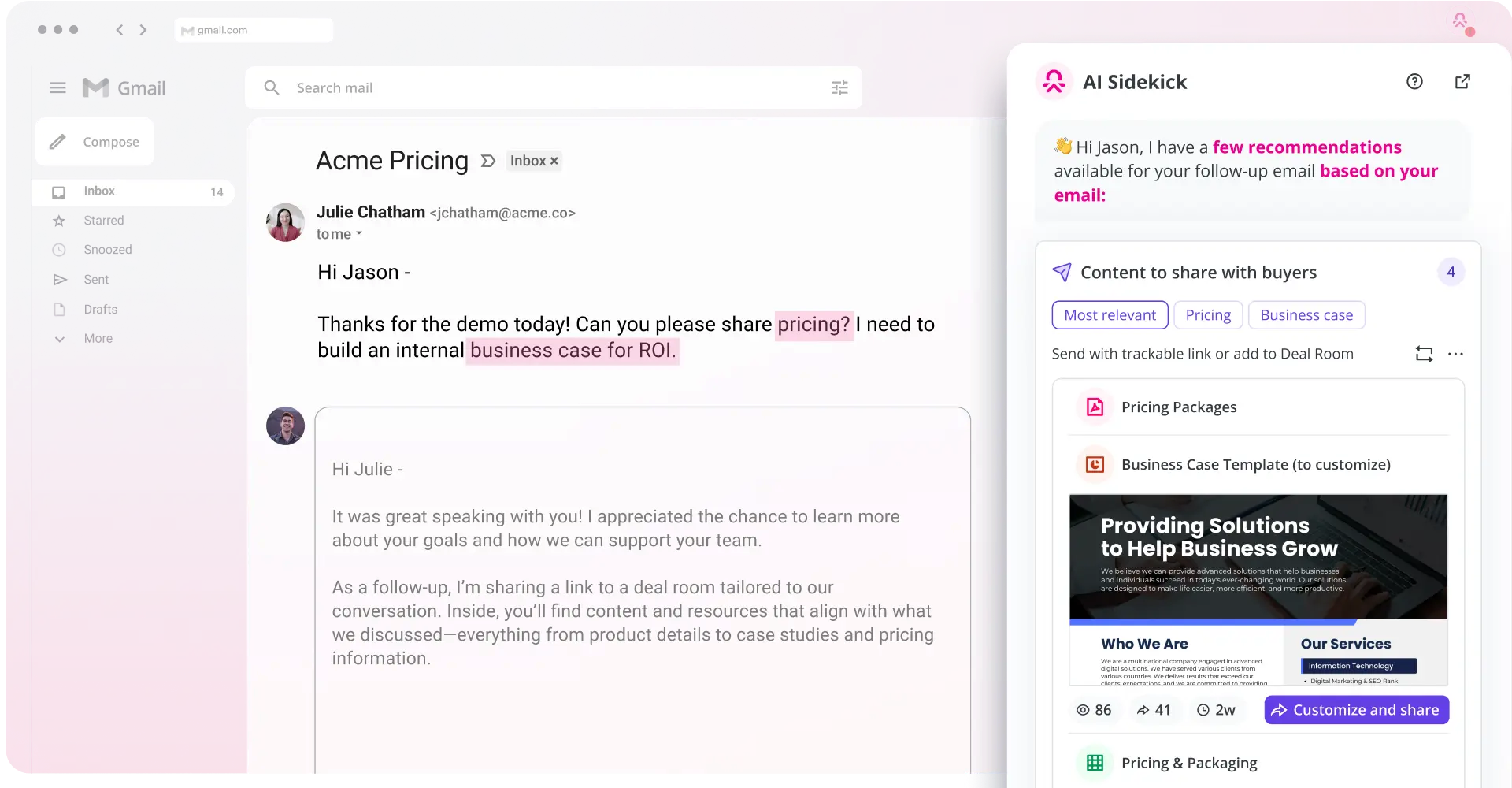
Key AI features for sales enablement
- AI Sidekick: Reps can ask questions in natural language from any integrated app and get context-aware answers, content suggestions, or messaging guidance. The assistant pulls from your knowledge base to deliver instant responses.
- Contextual content recommendations: Based on the current deal stage, CRM data, or call transcripts, Spekit surfaces relevant battlecards, playbooks, or templates without requiring manual search.
- Self-organizing content library: AI automatically tags and organizes content synced from Google Drive or other sources, aiming to reduce content rot by keeping the library current.
- Real-time alerts and updates: Push notifications keep reps informed of new messaging, content changes, or process updates—useful for fast-moving teams that need to stay aligned on positioning.
- Usage analytics: Dashboards show how reps engage with content, which playbooks get used, and where knowledge gaps exist, helping enablement teams iterate on what's working.
What to know
Spekit's AI is more reactive than generative: it surfaces existing content intelligently rather than creating new materials. If your use case is helping reps find the right battlecard or playbook instantly, Spekit's AI does that well. If you need AI to generate personalized proposals or business cases, consider platforms with stronger document-generation capabilities.
Spekit pricing
Spekit pricing is not publicly listed. Based on similar tools in the category, you can expect to pay between $3k-$50k annually, depending on the size of your team.
8. Salesforce Sales Cloud
Salesforce is the dominant CRM platform, and the company is betting heavily on AI through its Einstein and Agentforce layers. The goal is to embed predictive insights, automation, and conversational AI directly into the system where most sales teams already live.
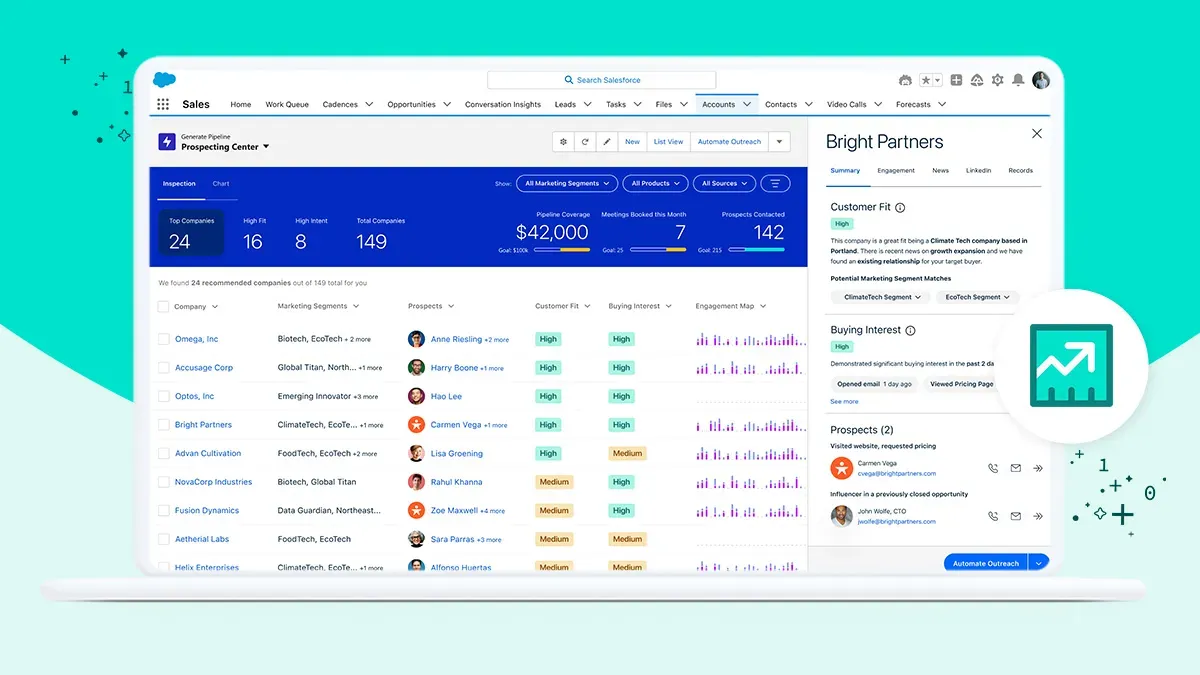
Key AI features for sales enablement
- Einstein AI activity capture and automation: Auto-syncs emails and calendar events to records, reducing manual data entry.
- Deal and lead scoring: Uses machine learning (ML) to score leads and opportunities based on historical patterns and engagement signals.
- Opportunity insights and alerts: Flags deals at risk, suggests next steps, and surfaces signals that need attention
- Copilot/AI assistant: Embedded AI assistant that helps reps with drafting, summarization, and sales guidance (via Salesforce’s AI tools).
- Forecasting and analytics: AI-powered forecasting features help leaders anticipate pipeline trends and identify gap areas.
What to know
Salesforce is the system of record for most B2B sales teams—the central hub where deal data, activity history, and forecasts live.
Therefore, its AI capabilities are solid for data hygiene, scoring, and forecasting, but most teams still rely on specialized tools for the enablement layer: content management, training, coaching, and buyer collaboration. Salesforce handles the "what's happening" layer; other tools handle the "how to execute" layer.
Salesforce Sales Cloud pricing
Salesforce’s core CRM tiers (Starter through Enterprise) cover standard sales automation, but AI features live behind the Einstein and Agentforce layers. Sales Cloud Einstein adds predictive forecasting, lead and opportunity scoring, and conversation insights, starting at around $100 per user per month.
The Agentforce 1 Sales SKU—Salesforce’s full generative AI suite—lists at $550 per user per month (billed annually) for access to copilots, workflow automation, and conversation intelligence across Sales Cloud.
9. HubSpot Sales Hub
HubSpot is the other major CRM player, and like Salesforce, the company is layering AI throughout its platform. The Breeze AI suite now handles email drafting, task automation, and predictive insights directly inside the CRM.
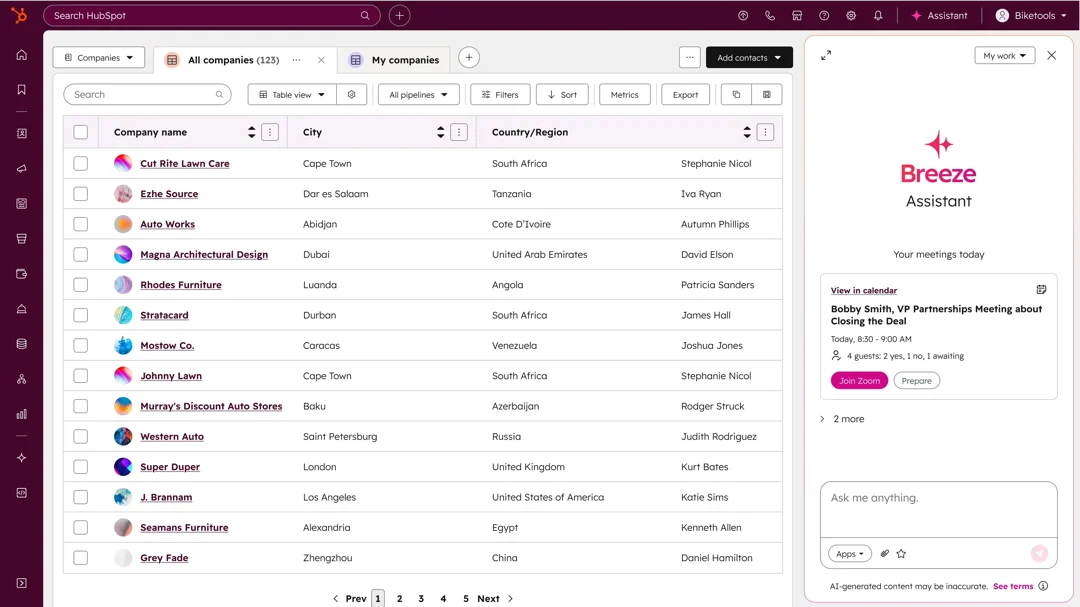
Key AI features for sales enablement
- Breeze AI assistant: Generate or refine sales emails, suggest content, and automate repetitive tasks from within the HubSpot interface.
- Guided selling and next-best actions: Sales Hub surfaces tasks and content for reps based on real-time buying signals, helping them prioritize work that matters.
- AI-powered reporting assistant: Change data views or generate reports on the fly using natural language prompts.
- Predictive leads and deal insights: Use AI scoring and trend analysis to highlight high-potential leads and surface risk in deals.
What to know
HubSpot's AI capabilities are tightly integrated into its CRM ecosystem, making them accessible for teams already invested in the HubSpot platform. The AI works best for mid-market teams who want straightforward automation and guidance without heavy configuration.
However, like Salesforce, HubSpot is strongest as a system of record—most teams still use specialized enablement tools for content management, coaching, training, and buyer collaboration rather than relying solely on HubSpot's native features.
HubSpot Sales Hub pricing
HubSpot's Breeze AI is available in the Professional and Enterprise tiers. Professional starts at $100 per user per month (billed annually), with Enterprise starting at $150 per user per month. Breeze AI features use a credit-based system for usage-based capabilities like content generation and email assistance.
10. Salesloft
Salesloft positions itself as a “revenue orchestration platform”, combining outbound engagement, pipeline management, and AI-powered workflow automation in one system.
The platform has leaned heavily into AI agents—26 in total as of early 2026—designed to automate repetitive tasks and help reps prioritize the actions most likely to move deals forward.
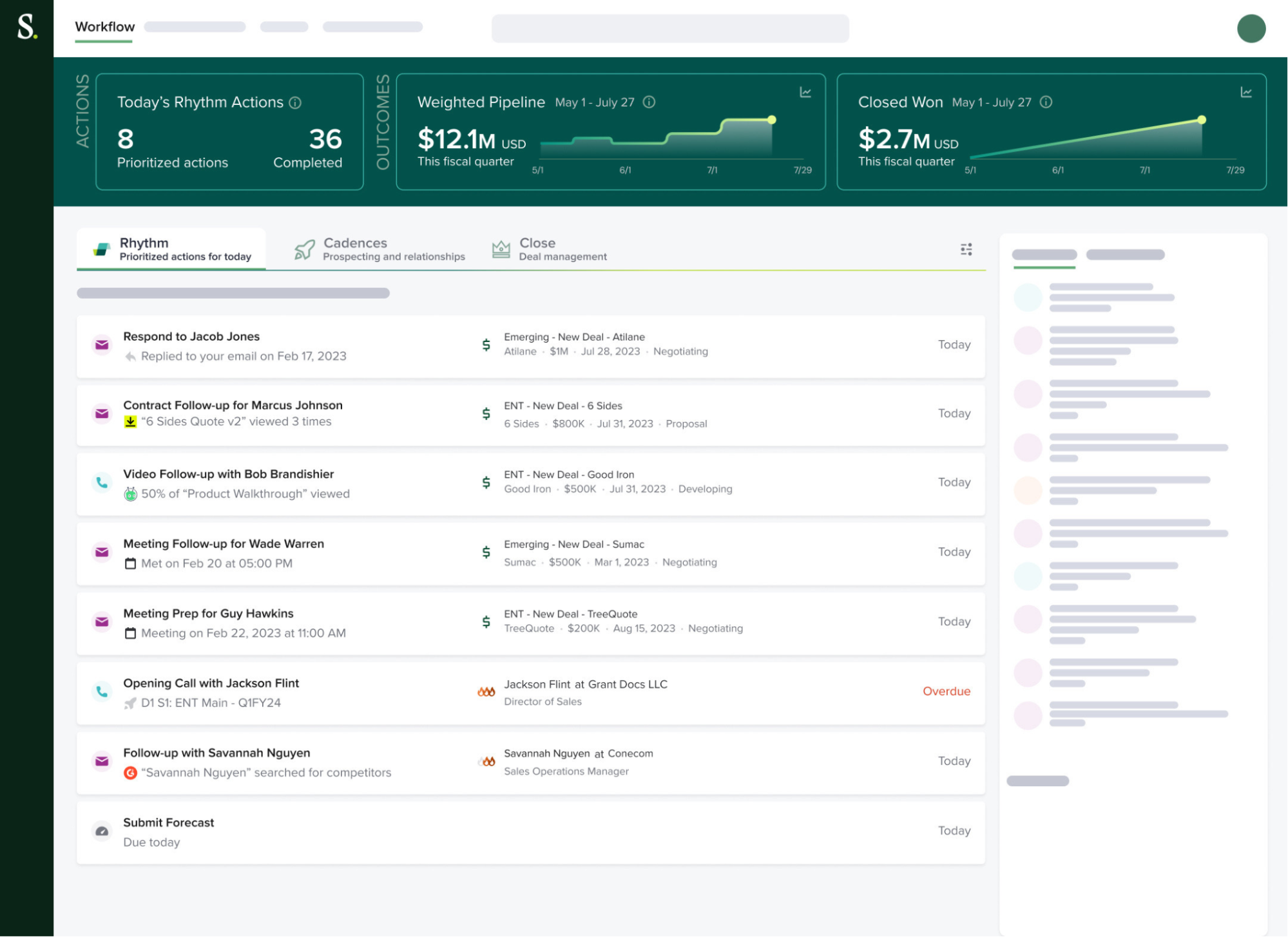
Key AI features for sales
- Conductor AI and Rhythm: AI agents analyze deal signals, engagement history, and pipeline data to recommend which accounts and opportunities reps should focus on next, creating a prioritized daily workflow.
- Deal summaries and Ask Salesloft: Conversational AI generates deal summaries on demand—identifying risks, tracking stakeholder engagement, and suggesting next steps based on CRM and activity data.
- Account and buyer research agents: Automatically gather buyer insights on target accounts, key stakeholders, and relevant context for outreach, pulling from CRM data, web sources, and engagement history.
- Embedded AI and workflow integration: AI is woven directly into Salesloft's cadence engine, CRM syncing, and forecasting tools, so insights surface in context without requiring reps to switch tools or run manual reports.
What to know
Salesloft's Rhythm orchestration engine is strong for managing outbound sequences and keeping reps focused on high-priority actions. However, it's primarily an execution platform—focused on outreach, follow-up, and activity management. Most teams use Salesloft for engagement workflows while relying on separate tools for content management, buyer collaboration, and training.
Salesloft pricing
Salesloft does not publish public pricing. According to Vendr, for 25 users on the “Advanced” tier, expect a contract of around $40k annually.
Competitors worth considering
Outreach, Apollo, and Revenue.io offer similar AI-powered engagement and sequencing capabilities with varying levels of analytics depth and CRM integration.
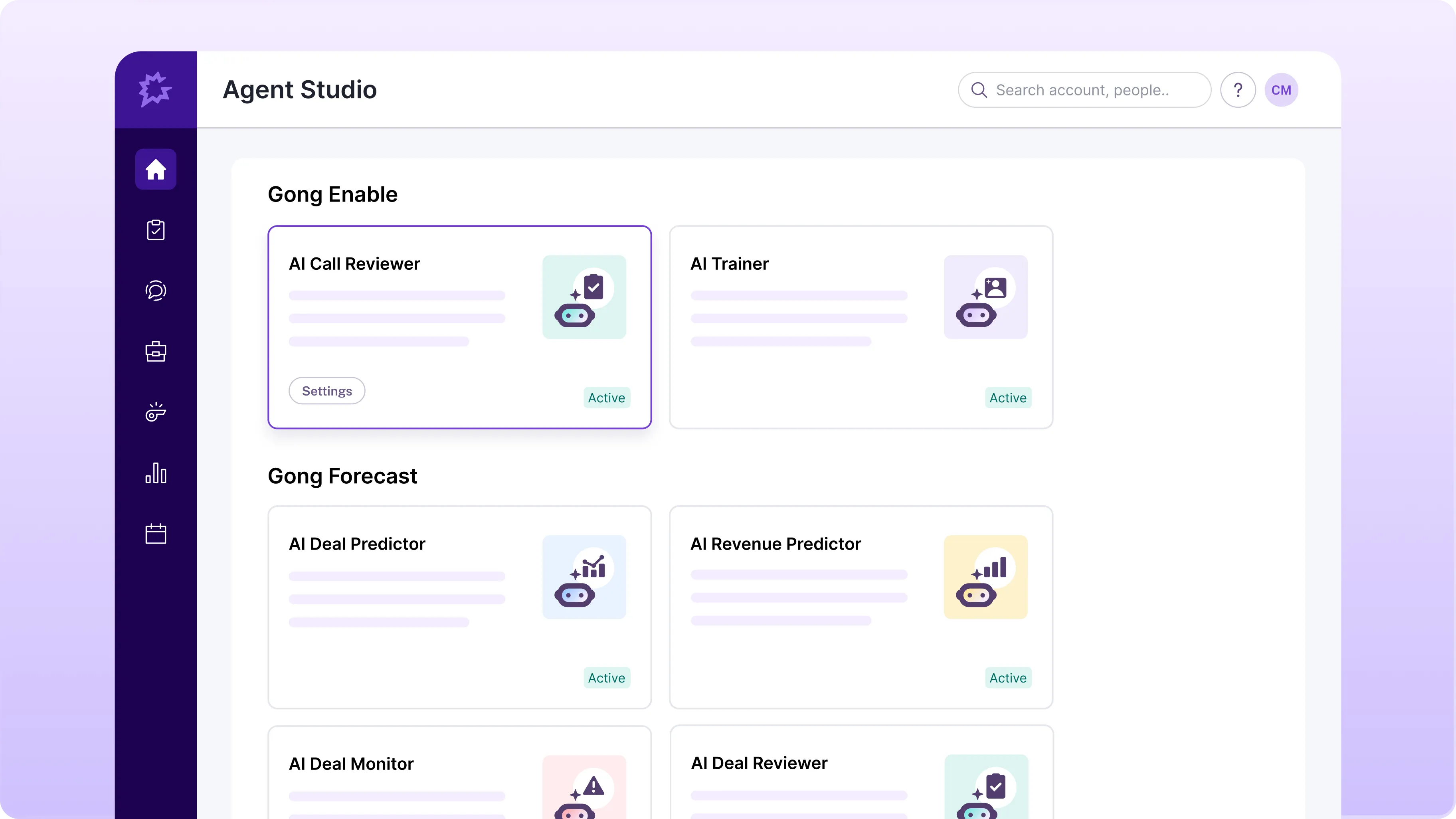
11. Gong
Gong is the category leader in conversation intelligence, using AI to analyze every sales call, email, and meeting to surface what's actually happening in deals—not just what reps log in the CRM.
The platform's AI tracks talk time, buyer engagement, question patterns, and sentiment shifts to identify which deals are healthy, which are at risk, and where managers should coach.
Key AI features for sales enablement
- Reality Platform: Gong’s core AI engine analyzes every buyer touchpoint—calls, emails, and meetings—to surface trends and risks.
- Deal intelligence: Automatically highlights at-risk deals and missed stakeholder engagement, providing visibility across the pipeline.
- Coaching AI: Scores calls, identifies skill gaps, and recommends clips or follow-ups for managers.
- Gong Agents: 20+ agents that can do tasks like reviewing and predicting deals, compose emails, spot themes, and lots more.
- Revenue forecasting: Predicts deal outcomes using engagement signals and historical patterns, giving sales leaders an objective view of pipeline health.
- AI email assist: Drafts personalized outreach and follow-ups based on conversation context.
What to know
Gong is the insight layer—it tells you what's happening in your deals and where to focus coaching efforts. Most teams use Gong's intelligence to inform their enablement strategy, then rely on other tools to execute: content platforms for finding the right materials, deal rooms for buyer collaboration, and training systems for skill development. Gong captures the data; other tools turn that data into action.
Gong pricing
Gong doesn't publish public pricing. Avoma reports a platform fee around $5,000 per year, plus $1,360–$1,600 per user annually. Vendr cites a 100-user deal negotiated to roughly $122,000 per year.
Competitors worth considering
Chorus, Avoma, and Fireflies.ai offer similar AI-powered conversation intelligence and coaching capabilities, with varying levels of automation, analytics depth, and CRM integration.
12. SecondNature
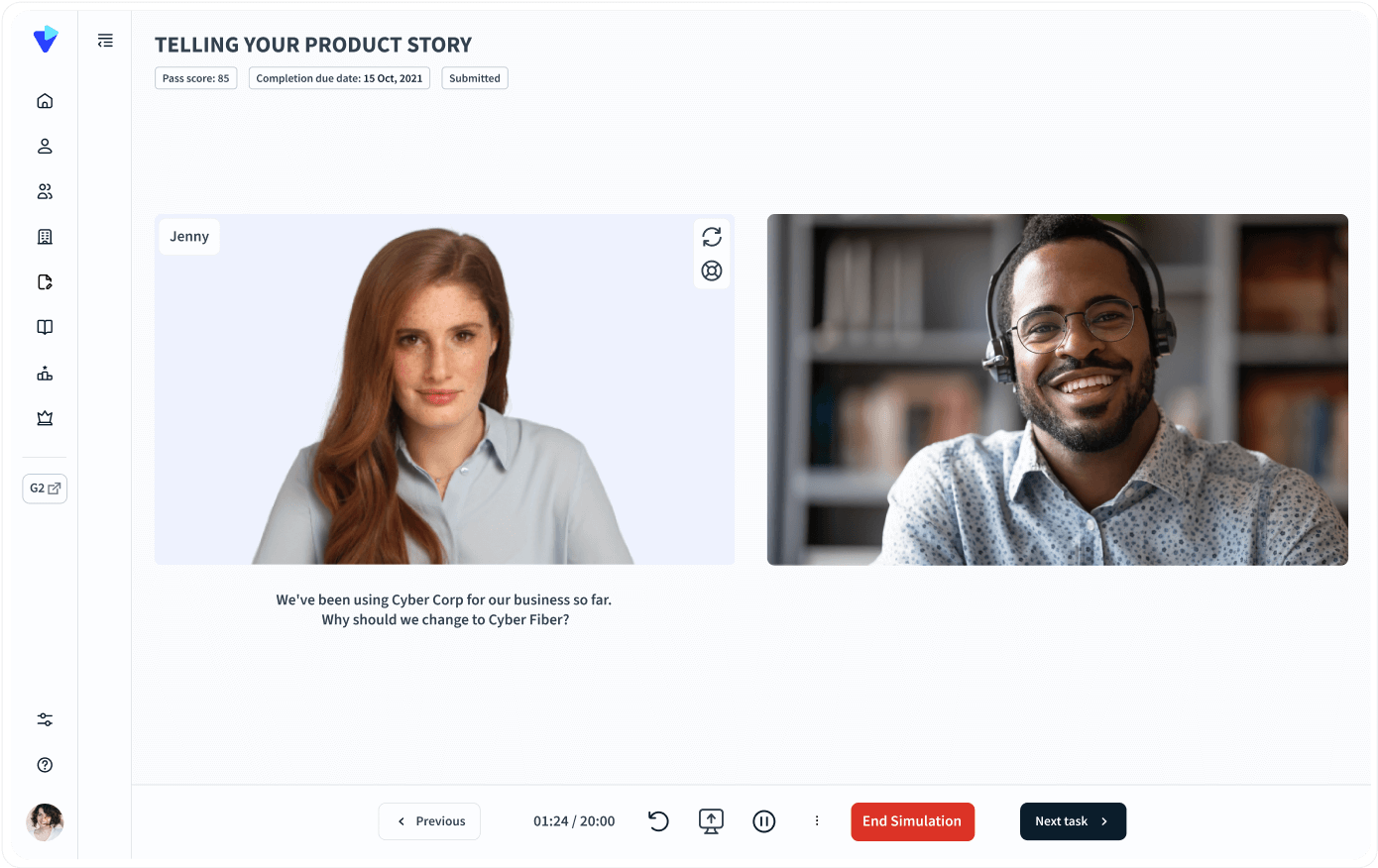
SecondNature is an AI-native sales coaching platform for enablement teams, designed specifically for practicing and improving pitch skills through conversational AI role-play.
The platform uses an AI avatar ("Jenny") to simulate realistic buyer conversations, giving reps a safe environment to practice objection handling, discovery questions, and product messaging without waiting for manager availability.
Key AI features for sales enablement
- AI role-play coach: SecondNature's AI avatar conducts realistic sales conversations, adapting responses based on what reps say and providing instant feedback on messaging, tone, and objection handling.
- Auto-scoring and feedback: Automatically evaluates rep performance across multiple dimensions—talk time, question quality, objection responses—and benchmarks results against team averages and top performers.
- Scenario personalization: Create tailored practice sessions by role, region, or product line, so reps can train on what they’ll actually sell.
- Analytics and readiness insights: Track progress, coachability, and message consistency with dashboards that tie training to pipeline outcomes.
- Integrations: Syncs with CRM, LMS, and enablement tools like Salesforce, HubSpot, and Lessonly.
What to know
SecondNature excels at one thing: giving reps unlimited practice without requiring manager time. The AI role-play is strong for building confidence and reinforcing messaging consistency.
However, it's a point solution focused specifically on practice and readiness—teams will still need separate tools for content management, deal execution, and buyer collaboration. Best suited for organizations that prioritize pitch readiness and want to scale coaching across large or distributed teams.
SecondNature pricing
Second Nature’s pricing is quote-based. According to marketplace intelligence, the median buyer pays about $19,000 per year.
Competitors worth considering
Letter AI, Rehearsal, Quantified, and Allego offer similar AI role-play and coaching capabilities, with varying levels of scenario depth and integration with existing sales enablement platforms.
13. Trellus.ai
Trellus is an AI-powered cold-calling copilot and embedded parallel dialer built for sales development teams that operate within sales engagement platforms (SEPs) like Salesloft, Outreach, and HubSpot. It’s designed to increase call volume and improve conversation quality without forcing reps to switch between different tools.
Key AI features for sales enablement
- AI Parallel Dialer: Dials up to five numbers at once directly within your existing SEP, automating voicemail drops and dramatically increasing the number of live conversations.
- Real-Time AI Coaching: Acts as a copilot during live calls, providing reps with instant guidance on objection handling, competitor mentions, and staying on message.
- AI Voice Agents: Allows reps to practice their pitch against an AI bot that simulates realistic customer conversations, providing a safe environment for training and skill development.
- Conversational Analytics: Automatically scores 100% of calls, tracking metrics like talk time, question patterns, and sentiment to identify coaching opportunities and replicate what top performers are doing.
- Virtual Sales Floor: A collaborative space for remote teams to listen to live calls, share tips, and celebrate wins, recreating the energy of a physical sales floor.
What to know
Trellus is a point solution focused on solving the specific challenges of high-volume outbound calling. Its strength lies in its deep integration with popular SEPs, which eliminates the context switching that plagues many sales workflows. It's not a full-stack enablement platform trying to be more than it is. It's solely focused on making reps more effective during the most critical part of their day: live conversations. It’s an ideal choice for SDR teams looking to boost their call volume and improve their reps’ performance on the phone.
Trellus.ai pricing
Trellus offers several pricing tiers, starting with a “Power (Bring Your Own Dialer)” plan at $59.99 per user per month. The “Power” plan, which includes a dialer, is $99.99 per user per month, and the “Parallel” plan, with multi-line dialing, is $149.99 per user per month. Custom pricing is available for teams with additional requirements.
Competitors worth considering
Nooks, Orum, and Abstrakt offer similar AI-powered dialing and coaching capabilities.
14. Cleanlist
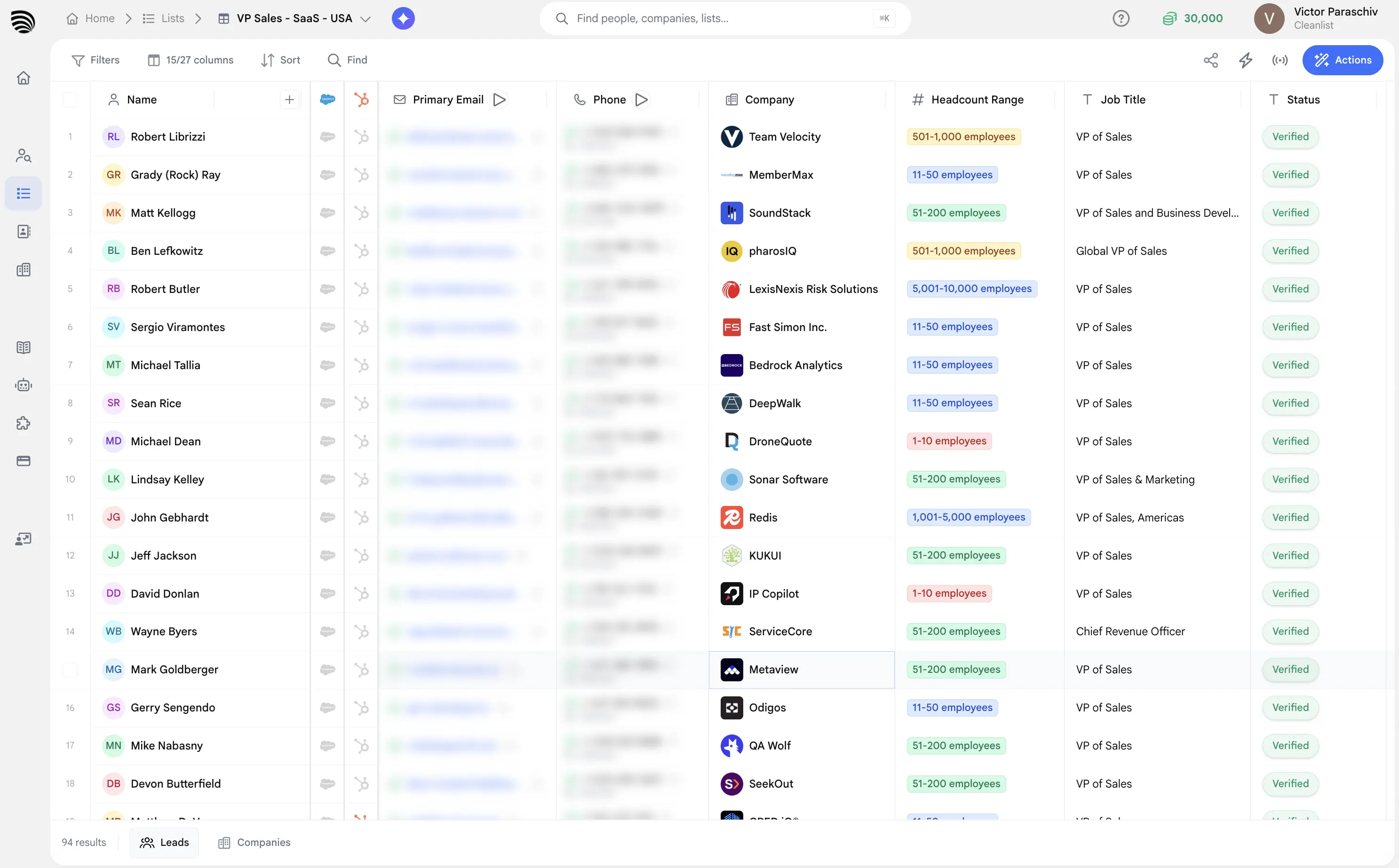
Cleanlist is an AI-native prospecting and enrichment layer that sits underneath the rest of your enablement stack. It holds no contact database of its own.
Every record is queried live across a waterfall of 15+ data providers, validated, and enriched with AI research columns before it reaches your CRM, which matters because every AI tool downstream of your contact data inherits whatever is wrong with it.
Key AI features for sales enablement
- Copilot list building: Describe an ICP in plain language, for example “Series A fintech companies in New York with a VP of Sales”, and Cleanlist assembles, enriches, and scores the list without anyone touching a filter panel.
- 15+ provider waterfall: Each contact is queried across 15+ enrichment vendors in sequence until a verified email or direct dial comes back, so coverage never depends on one vendor’s database. Credits are only consumed when new data is actually returned.
- Email and phone validation: Every address is validated and scored for deliverability (Deliverable, Risky, Undeliverable) with catch-all detection, and every number is checked for line type, so reps aren’t burning sequence steps and dial time on records that were never going to connect.
- AI research columns: Per-row agents produce an ICP fit score against your own definition, a one-line company summary, a competitor and tech read, and a pain-point hypothesis. That context is what makes personalized outreach and account plans possible at volume instead of one rep at a time.
- MCP server: Cleanlist runs a Model Context Protocol server, so Claude, Cursor, or any MCP-aware assistant can search and enrich lists inside a chat window and push the results back out to the CRM. Available from the Starter plan up.
What to know
Cleanlist is a prospecting point solution, not a content platform, a coaching tool, or a sequencer. And it does not send email or place calls. It is the data layer those tools run on, so teams pair it with an engagement platform for sending and a deal room for the buyer-facing side of the cycle.
Cleanlist pricing
Cleanlist has a free plan with 30 credits. Paid plans range from $79 per month to $599 per month—with 25% off on all plans if you choose annual billing. Credits are spent on results: 1 for a verified email, 10 for a phone number, 11 for both.
AI sales enablement capabilities checklist
Most companies don't need ten tools. They need a CRM plus two or three focused platforms that cover the core enablement jobs: content, coaching, and buyer collaboration.
Instead of adopting AI for AI's sake, map what each tool actually does against what you need to accomplish.
Here are the key capabilities to evaluate
✅ 1. CRM integrations: Does the tool play nicely with your CRM; syncing data both ways without extra manual work? The best AI tools use your CRM as the single source of truth for deal context, activity tracking, and reporting, rather than creating yet another data silo.
✅ 2. Buyer collaboration: Does the platform make it easy for reps and buyers to stay aligned throughout the deal? Look for tools that support shared spaces, track buyer engagement, and help champions access everything they need to make internal decisions without endless back-and-forth.
✅ 3. AI capabilities and vision: Does the company have a clear AI roadmap? Look for vendors who can articulate how their AI fits into your broader enablement workflow: how it connects with your CRM, how it learns from your data, and how it’ll evolve alongside your stack.
✅ 4. Coaching and readiness: Does the platform help reps get better in the flow of work? That could involve analyzing calls, simulating role-plays, or recommending content based on what’s missing in the pitch.
✅ 5. Content organization and delivery: How easily can reps find what they need, when they need it? The best platforms use AI to surface the right content in context; minimizing clicks, cutting down search time, and keeping sellers focused on selling instead of file hunting.
✅ 6. Forecasting and analytics: Can the system tie buyer engagement data back to pipeline accuracy? For example, Dock tracks which stakeholders view content, how often, and for how long, giving you the raw signals you need to optimize content and coaching.
✅ 7. Administrative lift and implementation: How much upkeep does the tool actually require? Some platforms need a full-time owner just to manage content, permissions, and integrations, while others work right out of the box. Look for something powerful enough to scale but simple enough to run without a dedicated ops headcount.
AI sales enablement software FAQs
What is AI sales enablement software?
AI sales enablement software uses artificial intelligence to help sales teams access the right content, training, and insights at the right time. It automates tasks like content recommendations, call analysis, deal forecasting, and rep coaching to improve productivity and win rates.
Some AI enablement platforms also power buyer-facing capabilities—like personalized deal rooms, AI-generated business cases, and engagement tracking—to help reps collaborate with buyers and accelerate deals.
How much does AI sales enablement software cost?
Pricing varies widely.
- Point solutions for coaching or role-play typically start at $13,000-$20,000 per year for small teams.
- Enterprise enablement platforms like Seismic, Highspot, and Mindtickle often start at $50,000–$100,000 annually.
- Dock offers more accessible pricing, starting at $350/month for 5 users on the Standard plan and $750/month for Premium.
- CRMs with AI add-ons (like Salesforce Agentforce) can run $100-$550 per user per month, depending on features.
What's the best AI sales enablement platform?
There's no single "best" platform—it depends on your needs.
- Dock excels at buyer collaboration and AI-powered deal rooms
- Gong leads in conversation intelligence
- Seismic and Highspot are strong for enterprise content management
- Mindtickle focuses on readiness and coaching
Choose based on which problems you need solved first.
Which AI sales enablement software can integrate with my CRM?
Most modern AI sales enablement platforms integrate with major CRMs like Salesforce and HubSpot. The depth of integration varies—some sync data both ways automatically, while others require manual configuration. Check whether the platform treats your CRM as the source of truth or creates a separate data silo.
Is AI sales enablement software replacing sales enablement teams?
No. AI sales enablement software amplifies what enablement teams can accomplish, not replace them. It automates time-consuming tasks like tagging content, generating training materials, scoring role-plays, and summarizing calls—freeing enablement professionals to focus on strategic work like designing programs, coaching managers, and tying enablement to revenue outcomes.
AI handles scale. Enablement teams provide the strategy and human judgment.
How do I measure ROI on AI sales enablement software?
Track sales enablement metrics like time-to-first-deal for new reps, win rates, deal cycle length, content usage vs. deal outcomes, quota attainment, and forecast accuracy. The best platforms connect enablement activities (training completion, content usage, buyer engagement) directly back to pipeline and revenue impact.
What does it mean to be an AI-native sales enablement platform?
An AI-native platform is built with AI at its core from day one (or close to it), rather than adding AI features to an existing system. These tools use AI to power fundamental workflows—like generating content, surfacing recommendations, and analyzing engagement—not just as a bolt-on feature.
Platforms like Dock, Letter AI, and SecondNature are AI-native, while Seismic, Highspot, and Showpad have layered AI on top of decade-old architectures. AI-native tools tend to be faster to configure and more intuitive to use.
Try Dock's AI-powered revenue enablement
Dock unifies content, coaching, and buyer collaboration in one AI-native platform—built to help revenue teams close deals faster without adding complexity to your stack.
Sign up for free or request a demo to see how Dock AI works in action.


Related Revenue Lab Articles

.webp)


Templates for Sales, Onboarding,
Projects and Portals
Customize and share with clients


