


Trying to budget for a sales enablement platform feels like a game you’re not meant to win.
You've visited five vendor websites. Four of them say "contact sales" where the pricing should be. The fifth shows a calculator that requires your email, phone number, and a 30-minute demo before revealing a number.
That number, by the way, might not even be the real number.
The most expensive mistake in sales enablement isn't picking the wrong platform—it's signing a three-year contract before you understand how the pricing actually works.
Most vendors price in a way that makes apples-to-apples comparison nearly impossible—with custom quotes, seat minimums, modular add-ons, and annual escalations that compound quietly over time.
A platform that quotes $90K annually can easily become a $343K three-year commitment once you factor in implementation, migrations, and price increases.
This guide provides the transparency the market won't. You'll learn:
- How platforms price their products
- What nine major vendors actually cost
- How to spot hidden fees and contract traps
- How to build a business case that survives CFO scrutiny

Our pricing research methodology
Pricing data in this guide comes from vendor websites, G2 reviews, Reddit, third-party procurement platforms (primarily Vendr), and other public sources, collected as of early 2026. Where public pricing isn't available, we've used reported contract ranges from verified buyer data.
All of the vendors on our list frequently tinker with their pricing. Treat these figures as directional benchmarks, not guaranteed quotes. Your actual number will depend on team size, contract length, and negotiated discounts.
When in doubt, contact vendors directly for current pricing—but use these benchmarks to pressure-test whether the quote you're being given is reasonable.

How much do sales enablement platforms cost?
Most sales enablement platforms cost between $12,000 and $200,000+ annually. The range depends almost entirely on team size, features needed, and depth of integrations.
- Enterprise (500+ sellers): $150K–$500K+. Seismic, Highspot, and Mindtickle live here. Budget for 4–6 month implementations and at least one FTE to manage the platform.
- Mid-market (50–500 sellers): $30K–$200K. Dock, SalesHood, and Showpad cover the full range. Seismic and Highspot at the high end.
- Small team (5–50 sellers): $12K–$50K. Watch out for 50–100 seat minimums that force you to overbuy.
- Startup or pilot (1–5 users): $3K–$15K. Most enterprise platforms won't serve teams this small. Dock starts at 5 users ($4,200/year).
Typical pricing factors
Most sales enablement platforms use per-user pricing, billed annually upfront. Some vendors have monthly billing. The final contract value depends on:
- Per-user or per-seat pricing: The primary cost driver for most platforms. Seats are often price tiered by role—full licenses for sales reps, contributor licenses for marketing or enablement teams, and viewer-only licenses for executives or other stakeholders.
- Seat minimums: Enterprise platforms often require 50-100 seat minimums, forcing smaller teams to buy unused capacity. Mid-market platforms typically start at 5-20 users with lower or no minimums.
- Contract length: Multi-year contracts unlock significantly better pricing—often 40-60% discounts on 3-year deals versus 20-40% on 1-year contracts. Many vendors strongly prefer 36-month terms with higher per-seat pricing for shorter commitments.
- Package or tier: Most vendors offer tiered packaging (e.g., Essential, Professional, Enterprise) with progressively more features. AI capabilities, advanced analytics, conversation intelligence, and digital sales rooms are often gated to higher tiers or sold as separate add-ons.
What's not included in base pricing
Even after you see a quote, there are often additional costs that surface later:
- Premium support and training: Many vendors offer tiered support. CSMs and hands-on training often come only in higher-tier packages or at an additional fee.
- AI and advanced features: AI-powered search, content recommendations, conversation intelligence, and coaching tools are frequently sold as add-ons or locked to enterprise tiers. What's marketed as an "all-in-one platform" often requires upgrades to access the most valuable features.
- Annual price increases: Many contracts include baked-in escalations of 8-12% per year. Over a 3-year contract, these compound significantly.
- Custom integrations: Standard CRM integrations are usually included, but custom API work can cost $5k-10k+.
- Overage fees: Exceeding your contracted seat count mid-term often triggers premium rates rather than pro-rated pricing.
Pricing breakdowns by vendor
Below are pricing breakdowns for nine major sales enablement platforms based on publicly available data, vendor websites, third-party pricing intelligence, and user reviews as of June 2026.
1. Seismic pricing
Best fit: Large enterprises (500+ employees) with dedicated enablement teams, complex content governance needs, and budgets to support 4+ month implementations and 12+ month time-to-ROI. Seismic excels when you need robust content management, LMS capabilities, and deep analytics—but only if you'll use all those features.
What you're paying for: Enterprise sales enablement platform combining content management, learning/training (LMS), coaching, and analytics. Includes AI-powered content search and recommendations, dynamic content personalization (LiveDocs), engagement tracking, workflow automation, and CRM integrations.
Pricing model: Seat-based, enterprise-focused, quote-only
Seismic operates on a tiered pricing model with two primary editions: Professional and Enterprise Premier. No public pricing is available—all quotes are custom, based on seat count, contract length, and feature bundle.
Typical contract size: $40,000–$180,000+ annually
Based on Vendr's procurement data:
- 100 seats (Professional): ~$42,700/year after typical discounts (list price $63,000)
- 250 seats (Professional): ~$126,000/year after discounts
- 500 seats (Enterprise Premier): ~$180,800/year after discounts (list price $315,000)
Most mid-market teams pay $40,000–$80,000 annually, while enterprise deployments commonly exceed $150,000–$250,000+.
Key cost drivers:
- High seat minimums: Seismic targets organizations with 100+ users. Smaller deployments are rare and don't receive favorable pricing.
- Implementation fees: Professional services typically cost $5,000–$50,000+, depending on complexity, with average implementation timelines of 4 months.
- Multi-year contracts: Seismic strongly encourages 3-year commitments, which unlock 45–78% discounts (median 62%) but lock you in. One-year contracts can see discounts of 20–51% (median 32%).
- Bundled modules: Seismic Content + Seismic Learning bundles are often pushed together even if you only need one. Learning adds ~$362/seat annually at list price.
- Add-ons: Salesforce Connector (~$69/user/year), Aura Copilot AI features ($0–$50+/user/month depending on negotiation), Interactive Content, LiveSocial tools.
- Annual price escalation: 8–12% annual increases are standard unless locked in with multi-year deals.
What makes it expensive: The total cost of ownership extends far beyond licensing. Factor in professional services, integration costs, ongoing admin resources (most customers assign at least one FTE to manage Seismic), training, and the opportunity cost of a 4-month rollout. For mid-market teams, Seismic is often overkill—and the complexity leads to poor adoption.
Sources:
- Vendr Seismic Marketplace page (accessed January 2026)
- G2 Seismic Reviews (January 2026)
- Seismic Professional Services page (January 2025)
2. Highspot pricing
Best fit: Mid-market to enterprise organizations (200+ employees) with established enablement functions needing comprehensive content management, training, and coaching in a unified platform. Works well for teams that want strong AI capabilities, deep CRM integrations at no extra cost—but are prepared for the price tag and learning curve.
What you're paying for: Enterprise sales enablement platform combining content management, AI-powered search and recommendations, sales training and coaching, buyer engagement tracking, and analytics. Includes Highspot Copilot (generative AI for real-time guidance), role play and skill assessment tools, guided selling playbooks, and meeting intelligence. CRM integrations (Salesforce, HubSpot, etc.) are included at no extra cost.
Pricing model: Seat-based with multiple license types, enterprise-focused, quote-only
Highspot uses tiered licensing: full platform licenses, Learning-Only licenses ($67/user/year), and Partner licenses ($183/user/year). No public pricing—all quotes are custom, based on seat count, license mix, modules selected, and contract length.
Typical contract size: $80,000–$150,000+ annually
Based on Vendr's data from 62 Highspot deals:
- Average contract: ~$91,460/year
- 100 full platform licenses: ~$110,000/year at list price (negotiable down to $70,000-$85,000 with discounts)
- 300-user hybrid deployment (mixing full, learning-only, and partner licenses): ~$129,200/year vs. $290,611 for all full licenses
Most mid-market teams report contracts in the $70,000–$120,000 range, while enterprise deployments commonly exceed $150,000+.
Key cost drivers:
- Seat minimums: Highspot typically targets deployments of 50+ users. Smaller teams can buy in but receive less favorable pricing.
- License type mix: Full platform licenses are significantly more expensive than Learning-Only or Partner licenses. Strategic mixing can save 31% on average.
- Modular pricing and add-ons: Highspot has shifted to modular pricing—AI features (Copilot), Advanced Analytics, and Premium Marketplace content are paid add-ons. Content & Guidance modules add $2,400- $3,600 annually, as a flat fee.
- Implementation services: Professional services typically cost $15,000-$45,000, depending on complexity. Content migration adds $8,000-$25,000. Custom integrations run $5,000-$15,000 each. Organizations spending $100,000+ annually often negotiate these fees as included.
- Premium support: Standard support included, but premium support (faster response times, dedicated CSM) costs $12,000-$25,000 extra, annually—though often waived for contracts over $75,000.
- Annual contracts required: Monthly billing is not available. Highspot does not increase prices at annual renewal, but discounts may erode over time.
What makes it expensive: Like Seismic, Highspot's modular pricing means you're often paying for features that were previously bundled. Implementation timelines and professional services add to first-year costs. The shift from all-inclusive pricing to add-on modules has frustrated long-time customers who now pay extra for AI and advanced analytics. Total cost of ownership includes not just licenses but implementation, content migration, training, and ongoing admin resources to manage the platform.
Sources:
- Vendr Highspot Marketplace page (accessed January 2026)
- Highspot Pricing Page (December 2025)
- G2 Highspot Reviews (January 2026)
3. Showpad pricing
Best fit: Mid-market to enterprise organizations (200–1,000+ employees) that need content management, visual presentation tools, and training capabilities. Showpad's UI/UX is highly rated, and the platform works well for companies that prioritize design and buyer experience—especially those in industries like medical devices where visual demos matter. A good fit for teams already using Salesforce and seeking deep CRM integration.
What you're paying for: Enterprise sales enablement platform combining content management, sales training (Coach module), buyer engagement tools (Shared Spaces), and analytics. Includes AI-powered content recommendations, search, and tagging, customizable buyer experiences, augmented reality for product demos, video recording tools, and CRM integrations.
Pricing model: Seat-based, tiered pricing, enterprise-focused, quote-only
Showpad uses annual contracts with three main tiers. New "eOS" packaging launched in 2025 consolidates previous plans. No public pricing—all quotes are custom, based on tier, seat count, and contract length.
Typical contract size: $42,000–$108,000+ annually
Based on third-party pricing research:
- Per-user pricing: $25–$45/user/month on annual contracts ($300–$540/user/year)
- 100-user deployment: ~$42,000–$54,000/year (Professional or Advanced tier)
- 200-user deployment: ~$84,000–$108,000/year
Most organizations pay in the $50,000–$100,000 range annually, with enterprise deployments exceeding $100,000+. Vendr's redline threshold estimate is $100,000.
Key cost drivers:
- Seat minimums: Showpad targets mid-market to enterprise teams. While smaller teams can buy in, pricing favors deployments of 50+ users.
- Tiered pricing with forced upgrades: Professional tier covers basic content and training; Advanced adds coaching, SSO, up to 10 divisions, and API access; Expert (top tier, quote-based) includes all AI features and priority support. Advanced features like buyer uploads and Mutual Action Plans now require the "Collaborate+" add-on bundle.
- AI feature gating: Most AI capabilities (AI-powered search, page builder, CRM recommendations) are locked to the Expert tier. Some beta AI features like AnalyticsIQ are available in lower tiers but may move to Expert after general availability.
- Annual contracts required: Monthly billing is not available. Licenses are annual only.
- Implementation and training: Setup and training costs vary but typically add several thousand dollars to first-year costs.
- Price increases at renewal: Vendr community data shows 8% price increases being applied at 12-month renewals unless multi-year deals are signed.
What makes it expensive: Showpad's shift to modular "eOS" packaging in 2025 means features that were previously included now require tier upgrades or add-on bundles. AI features are mostly gated to the expensive Expert tier. Like Seismic and Highspot, total cost includes not just licenses but implementation, training, ongoing admin, and potential price escalation at renewal. The platform requires dedicated resources to manage effectively.
Sources:
- Vendr Showpad Marketplace page (accessed January 2026)
- Showpad Help Center - Pricing Changes (2025)
- PAT Research Showpad Review (March 2024)
- Multiple comparison sites (Nuvue, G2, Capterra, SoftwareSuggest) citing $25-$45/user/month range
4. Mindtickle pricing
Best fit: Enterprise organizations (500–5,000+ employees) with large, distributed sales teams needing comprehensive training infrastructure. Mindtickle excels for companies that want to correlate training activities directly to revenue outcomes through CRM integration and readiness scoring. Strong fit for organizations focused on onboarding at scale, ongoing skill development with gamification, and conversation intelligence for call coaching.
What you're paying for: Enterprise revenue enablement platform focused on sales readiness, training, and coaching. Includes comprehensive LMS with gamification, AI-powered coaching (Mindtickle Copilot), conversation intelligence for analyzing sales calls, digital sales rooms, practice and role-play modules, content management, readiness analytics (Readiness Index that correlates training to CRM outcomes), and CRM integrations.
Pricing model: Seat-based, tiered packages, enterprise-focused, quote-only
Mindtickle uses four main packages with different feature sets. Pricing is entirely custom based on package selection, seat count, contract length (typically 36 months), and add-ons. No public pricing available.
Typical contract size: $90,000–$430,000+ annually
Based on Vendr's data from 30+ deals:
- Average contract: ~$92,000/year
- Per-user pricing: $30–$50/user/month ($360–$600/user/year) depending on package and volume
- 100-user deployment: ~$36,000–$60,000/year (before discounts)
- 1,000+ user deployments: Push for ~60% discounts on Enable package, bringing costs down significantly
Implementation fees add $3,000–$25,000, depending on complexity, with 6–8 week setup timelines typical.
Key cost drivers:
- Long-term contracts: Mindtickle strongly prefers 36-month (3-year) contracts. Shorter terms increase per-user pricing significantly.
- Package tiers: LMS (basic learning), Readiness (adds role-play and coaching), Enable (adds conversation intelligence and digital sales rooms), Transform (full platform with advanced AI). Higher tiers unlock critical features like conversation intelligence and AI coaching.
- Implementation and professional services: Setup costs $3,000–$25,000, with 40+ hours of Content-as-a-Service support included in some packages. Complex deployments that require CRM integration and custom content can increase implementation costs.
- Add-on modules: Call AI, conversation intelligence, and custom integrations often require additional fees beyond base packages.
- Volume discounts: Vendr community data shows that 1,000+ seat deployments can negotiate discounts of ~60%. Smaller teams receive less favorable pricing.
What makes it expensive: Mindtickle is training-first, not content-first—meaning it's built for organizations with dedicated enablement teams running structured programs. The platform requires significant admin overhead to build courses, manage cohorts, and analyze performance. Multi-year contract terms (typically 36 months) lock you in when needs might evolve. Add-ons for AI features and conversation intelligence increase costs beyond base licensing. Implementation timelines of 6–8 weeks mean delayed time-to-value.
Sources:
- Vendr Mindtickle Buyer Guide (accessed January 2026)
- RevPilots Mindtickle Pricing (April 2023)
- Subscribed.fyi Mindtickle Pricing (May 2025)
- G2 Mindtickle Reviews (January 2026)
- Mindtickle Subscription Services Description
5. Dock pricing
Best fit: Mid-market companies (100–500 employees, 5–200+ sellers) that need real enablement infrastructure without a 4-month implementation, a dedicated admin, or pricing opacity of enterprise platforms. Built for the full revenue team—Sales, Customer Success, Enablement, and Marketing— to collaborate with buyers and customers across the entire lifecycle, from first demo through renewal.
What you're paying for: An AI revenue enablement platform covering the full customer lifecycle—including deal rooms with mutual action plans and native e-signatures, client portals for onboarding and renewals, AI-powered content management with auto-tagging and version control, AI Documents that generate business cases and meeting recaps from CRM and call data, Playbooks and Courses for rep training, and an AI Enablement Agent for real-time rep guidance.
Pricing model: Transparent tier-based pricing, free plan available, low seat minimums, no implementation fees. External collaborators (prospects, clients, partners) have free access—only internal team members count toward seat limits.
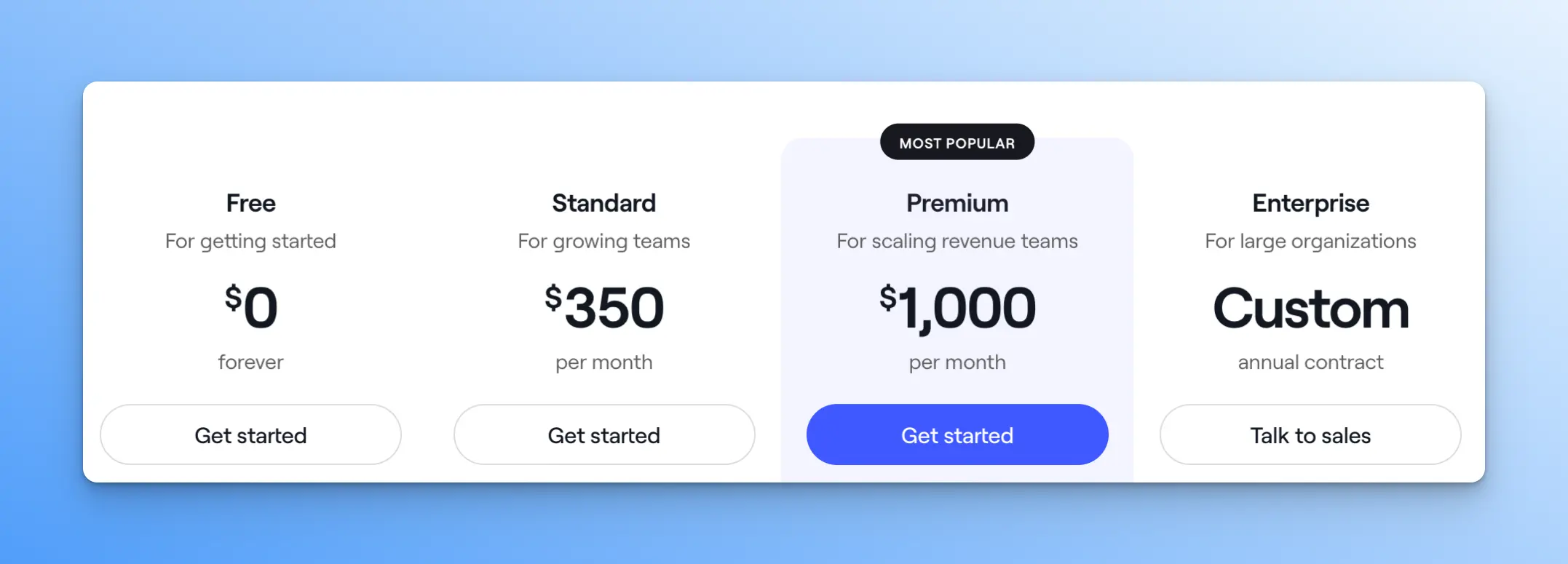
Dock offers a free plan plus three paid tiers. The free plan lets you try most of the platform on a small scale: 10 workspaces, content management (up to 25 assets), one playbook, one course, and one order form, with no time limit. Paid plans include unlimited workspaces, with a flat platform fee per tier and $50/month per-seat add-ons on Standard and Premium.
Typical contract size: $4,200–$100,000+ annually
Here is our pricing (as of June 2026):
- Free: 10 workspaces, 25 content assets, and one playbook, course, and order form each, with basic integrations and no time limit
- Standard: $350/month for 5 users — deal rooms, content management, Salesforce and HubSpot, and priority support
- Premium: $1,000/month for 10 users — adds Google Drive and SharePoint sync, unlimited playbooks and Courses (LMS), CRM-integrated order forms, custom fields, webhooks, and removes Dock branding
- Enterprise: Custom pricing — adds automations, API, custom domain, advanced SSO and SCIM, dedicated customer success, and managed implementation
For a full feature breakdown by plan, check out our pricing page.
Example pricing:
- 5-user team: $350/month = $4,200/year (Standard plan)
- 10-user team: $1,000/month = $12,000/year (Premium plan)
- 20-user team: $1,500/month = $18,000/year (Premium plan + 10 additional users)
- For larger teams: Inquire for a custom quote
Key cost drivers:
- Per-user pricing: $50/user/month for additional seats beyond the base 5 included in Standard/Premium
- Base package: $350/month for the first 5 users on paid plans
- No hidden costs: All features are transparently listed in our pricing plans
- Low seat minimums: Paid plans start at 5 users but scale up or down monthly
What makes it worth it: Consolidates 5-7 separate tools (DSR, content management, onboarding, learning management, e-signature, mutual action plans, client portals) into one AI-native platform. Fast implementation (days, not months), low admin burden, and transparent pricing with no professional services fees. Built for mid-market reality—not Fortune 500 compliance teams. Dock also offers a contract buyout program for companies locked into other platforms.
Source: dock.us/pricing
6. Spekit pricing
Best fit: Mid-market to enterprise sales teams (100–1,000+ employees) that want enablement delivered in existing workflows rather than in a separate platform. Ideal for Salesforce-heavy organizations needing content, training, and coaching surfaced contextually in CRM, email, and other tools.
What you're paying for: A modern enablement platform that delivers content, learning, and coaching directly in reps' workflow. Includes AI Sidekick for contextual recommendations, AI-powered content management, digital sales rooms, learning modules, and analytics. Combines knowledge management, CMS, and LMS in one platform.
Pricing model: Per-user subscription, quote-only
Spekit does not publish pricing on its website. All quotes are custom, based on team size, features needed, and contract length. Annual contracts typical.
Note: Spekit has significantly expanded from a simple knowledge tool to a full sales enablement platform, so current pricing likely reflects this broader capability set and may be substantially higher than older reported rates from when it was primarily a digital adoption platform (DAP).
Typical contract size: Pricing unavailable for current platform
Third-party sources cite historical pricing from 2023-2025 in the $10-$20/user/month range, but these rates predate Spekit's expansion into full enablement (AI Sidekick, Deal Rooms, comprehensive content management). Current pricing for the full platform is not publicly available and likely significantly higher.
Key cost drivers:
- Seat count: Per-user pricing scales linearly with team size
- Feature tier: Advanced features like AI Sidekick and Deal Rooms may require higher tiers
- Integration fees: Vendr community data shows Spekit now charges separately for some integrations that were previously free
- Contract length: Annual vs. multi-year commitments affect per-user rates
- Platform evolution: Pricing reflects shift from point solution to comprehensive enablement platform
What makes it different: Spekit has evolved from a lightweight DAP into a comprehensive enablement platform competing with Seismic/Highspot. The platform now delivers full-featured enablement in the flow of work rather than as a standalone tool. Current pricing requires contacting sales, suggesting enterprise-level positioning rather than the transparent, lower-cost structure of earlier versions.
Sources:
- Vendr Spekit Marketplace page (accessed January 2026)
- SaaSWorthy Spekit Pricing (December 2025)
- Dimmo Spekit Review (2025)
- G2 Spekit Pricing (2025)
7. Guru pricing
Best fit: Mid-market to enterprise companies (50–1,000+ employees) across customer support, HR, IT, and operations that need AI-powered knowledge access and automated knowledge management. Ideal for teams using Slack or Microsoft Teams who want AI answers surfaced in workflow. Strong fit for companies needing governance over AI usage and knowledge quality at scale.
What you're paying for: AI-powered workplace knowledge platform with five core use cases: Workplace AI Chat & Research (cited answers and deep research), Knowledge Management Automation (automated knowledge upkeep), Enterprise AI Search (AI-driven company search), AI-powered Company Wiki (automated knowledge base), and Team Hubs (custom employee engagement hubs). Includes 100+ integrations, MCP support to power Claude and ChatGPT, permission-aware AI, and automated verification workflows.
Pricing model: Usage-based with seat packages, published pricing
Guru offers two main pricing approaches: predictable seat-based packages for teams getting started, and usage-based pricing for scale. All plans include AI credits with usage limits.
Typical contract size: $15,000–$60,000+ annually
Guru's (previously published) pricing:
- Standard plan: $25/seat/month ($300/seat/year, or $30/month if billed monthly) - predictable pricing with included AI credits
- Enterprise plan: Custom pricing - true usage-based pricing built for scale and governance with included AI credits
Example pricing:
- 50-user team (Standard, annual): $1,250/month = $15,000/year
- 100-user team (Standard, annual): $2,500/month = $30,000/year
- 200-user team (Standard, annual): $5,000/month = $60,000/year
No free tier. Implementation fees not disclosed. Enterprise plan pricing requires contacting sales.
Key cost drivers:
- Seat count: Linear scaling at $25/seat/month on Standard plan
- AI credits: All plans include credits, but usage limits apply—high AI usage may require Enterprise plan
- Billing frequency: Monthly billing costs 20% more ($30/month vs. $25/month annual)
- Enterprise features: Custom pricing for true usage-based model and advanced governance
- AI consumption: Different AI capabilities consume varying credits based on task complexity
What makes it different: Guru is a cross-functional knowledge platform, not a purpose-built sales enablement tool. Focuses on AI chat, search, and automated knowledge management rather than training or content for revenue teams. At $25/seat/month, positioned as infrastructure for company-wide AI and knowledge access rather than an enablement-specific platform.
Sources:
- Guru Pricing Page (accessed January 2026)
- G2 Guru Pricing (September 2025)
- SaaSWorthy Guru Pricing (August 2025)
- Saufter Guru Pricing Breakdown (March 2025)
- Tools For Humans AI Guru Review (2025)
- Vendr Guru Marketplace (2025)
8. Allego pricing
Best fit: Mid-market to enterprise B2B companies (200–5,000+ employees) in regulated industries (financial services, life sciences, pharmaceuticals, medical devices, manufacturing) that need comprehensive training infrastructure with video coaching, conversation intelligence, and digital sales rooms. Strong fit for teams consolidating 5–7 enablement tools into one platform.
What you're paying for: AI-powered revenue enablement platform combining learning management (LMS/LXP), video coaching and role-play, conversation intelligence, content management, digital sales rooms, and reinforcement training in one system. Includes 120+ integrations, mobile-first video capabilities, AI-driven search and coaching, and analytics tracking of deal activity to revenue outcomes.
Pricing model: Per-user-per-month, billed annually upfront, quote-based
Allego uses tiered packaging with four plans: Modern Learning with Conversation Intelligence, Modern Content, Digital Sales Rooms, and Full Suite (all features). All pricing is custom and requires a sales contact.
Typical contract size: Estimated $50,000–$200,000+ annually
Third-party pricing data estimates suggest:
- Per-user range: $15–$30/month ($180–$360/year per user), depending on features and seat count
- Example estimates (based on third-party data):
- 100 users at $25/month = $2,500/month = $30,000/year
- 200 users at $20/month (volume discount) = $4,000/month = $48,000/year
- 500+ users: Custom enterprise pricing, potentially $100,000–$200,000+
Implementation: $5,000–$50,000+, depending on company size and customization needs. Training costs range from $500 to $1,000 per user for personalized sessions.
Key cost drivers:
- Seat count: Volume discounts apply at scale
- Contract length: 3-year contracts preferred (get better pricing than 1- or 2-year terms)
- User type: Partner/channel sales and non-revenue roles priced lower than core sales users
- Feature package: Modular pricing—Modern Learning vs. Content vs. Digital Sales Rooms vs. Full Suite
- Implementation scope: Customization, integrations, and content migration add costs
What makes it different: Emphasizes video-based learning, mobile-first design, and conversation intelligence. Claims to save up to 50% by consolidating LMS, coaching, content management, conversation intelligence, and digital sales room tools. Includes Premium Success Services and AI features at no extra cost. Offers a contract buyout program for teams locked into competing platforms.
Sources:
- Allego Pricing Page (accessed January 2026)
- SalesHive Allego Review (accessed January 2026)
- Research.com Allego Review (accessed June 2025)
- SoftwareFinder Allego (accessed January 2026)
9. SalesHood pricing
Best fit: Mid-market to enterprise B2B companies (100–2,000+ employees) in high-growth SaaS and technology sectors that need unified platform for training, coaching, content, and digital sales rooms. Strong fit for teams scaling enablement programs globally, especially those using Salesforce heavily or needing pre-built methodology content (MEDDPICC, Sandler, etc.).
What you're paying for: AI-driven revenue enablement platform combining sales training and onboarding, video-based coaching and role-play, content management with searchable library, digital sales rooms with mutual action plans, and CRM-integrated analytics. Includes AI Role Play, AI Pitch Practice, AI Answers, AI Call Recaps, AI Content Writer, and pre-built sales training templates (MEDDICC frameworks, methodology content).
Pricing model: Per-user-per-month, tiered packages, two published pricing tiers
SalesHood offers three tiers with published starting prices:
- Essential: ~$45/user/month (content management, learning management, deal rooms, basic AI, standard reporting)
- Pro: ~$75/user/month (adds AI Content, AI Search, AI Governance, custom reports, SAML SSO, CSM, priority support)
- Transform: Quote-based (adds services, expert guidance, tech stack consolidation)
Typical contract size: $27,000–$90,000+ annually
Pricing examples based on published rates:
- 50-user team (Essential, annual): $2,250/month = $27,000/year
- 50-user team (Pro, annual): $3,750/month = $45,000/year
- 100-user team (Essential, annual): $4,500/month = $54,000/year
- 100-user team (Pro, annual): $7,500/month = $90,000/year
Note: List pricing shown is $50/user/month according to Vendr and Capterra, which aligns with the Essential-to-Pro range. Discounts available for volume and multi-year contracts.
Key cost drivers:
- Seat count: Linear per-user pricing, volume discounts available
- Feature tier: Essential vs. Pro vs. Transform—AI features and advanced analytics locked to higher tiers
- Contract length: Multi-year contracts unlock better pricing; Vendr reports 10% annual uplift on 12-month renewals, 6% on 24-month renewals
- Discounts negotiated: Vendr community reports 20% "Friends and Family" discounts and flat renewals based on adoption trends
What makes it affordable: At $45–$75/user/month, positioned below Seismic, Highspot, and Mindtickle while including AI coaching, role-play, and digital sales rooms. Transparent published pricing eliminates quoting friction for mid-market buyers. Claims to reduce sales tech stack costs by 80% through consolidation.
Sources:
- SalesHood Pricing Page (accessed July 2025)
- Vendr SalesHood Buyer Guide (accessed January 2026)
- Capterra SalesHood Reviews (accessed January 2026)
- GetApp SalesHood (accessed January 2026)
- SoftwareFinder SalesHood (accessed January 2026)
How to evaluate pricing without getting burned
You've done your research. You understand how platforms price. Now you're sitting on a few quotes and need to make a decision. Here's what to focus on when the numbers are in front of you.
Consider the full cost, not just the license fee
The headline figure at the top of the quote isn't what you'll actually pay. Build the complete picture:
Year 1 costs:
- License fees (the headline number)
- Implementation and setup
- Content migration from your current system
- Integration work beyond standard connectors
- Training for your team
- Premium support (if not included)
Ongoing costs:
- Annual price increases (check the contract—many vendors bake in 8-12% annual escalations)
- Add-on modules you'll need later (AI features, advanced analytics, additional integrations)
- Admin and maintenance time (if the platform needs ongoing management, that's staff cost)
Example: A quote that says "$90K annually" might actually be:
- Year 1: $90K licenses + $20K implementation + $15K migration + $10K training = $135K
- Year 2: $90K + 10% increase = $99K
- Year 3: $99K + 10% increase = $109K
- 3-year total: $343K (not the $270K you'd assume from "$90K annually")
Write out the full 3-year cost for each vendor you're considering.
Map quoted seats to actual users who need them
Vendors might play games with seat counts to fit your budget. Some quote you for your entire revenue team (inflating the number). Others deliberately underquote, knowing you'll outgrow the contract in 6 months and need to expand at higher per-seat pricing.
Make a list of who needs access:
- AEs and managers: Full access (yes)
- Enablement team: Full access (yes)
- SDRs: Learning and content only (probably)
- Customer success: Content only or limited (depends)
- Marketing: Content only (maybe)
- Executives: Read-only dashboards (maybe)
Then compare against your quote:
If they over-quoted on seats, ask for some pricing flexibility. If they under-quoted on seats, ask what happens when you add 10 more reps. Then get that expansion pricing locked in writing.
Check what features are actually included
If half your feature must-haves are add-ons or gated to a higher tier, you're not comparing apples to apples with other quotes. Get the all-in price.
The question to ask: "This quote shows [X package/tier]—can you confirm which of these features are included versus requiring add-ons?"
Estimate the hidden time costs
Make sure you're comparing total cost and total time to launch, not just the license fee.
Two quotes might be similar on paper but wildly different in actual cost once you factor in time:
- Implementation timeline: Is this a 2-week setup or a 6-month project? The longer the timeline, the higher the cost and the longer it takes for your team to get value.
- Admin burden: Ask the vendor: "How much time per week does a typical customer spend managing the platform?" If it's more than 5-10 hours per week, you need to staff it. That's at least $25K-$50K in loaded labor costs annually.
- Training time: "How long until our reps are self-sufficient?" If the answer is measured in months or requires multi-day sessions, your team loses productivity during ramp.
Add up these time costs and factor them into your decision.
If you have a large enablement team and complex requirements, a longer implementation with more customization might be worth it. But if you're a leaner team that needs to move fast, implementation speed and ease of use matter more than feature depth.
Watch for contract traps
Before you sign, check for:
- Auto-renewal clauses: Some contracts auto-renew with price increases unless you cancel 60-90 days in advance. Miss the window, you're locked in another year.
- Seat minimums on growth: Some vendors require you to maintain or increase seat count at renewal, even if your team shrinks.
- Forced upgrades: "You're in the Professional tier now, but if you want [new feature], you'll need to upgrade to Enterprise." Get pricing locked for add-ons you might need later.
- Unclear exit terms: What happens to your data if you cancel? Is export easy, or do they hold your content hostage?
The gut-check question
You're about to spend $50K, $100K, or $200K+ annually. Before you sign, ask: "Will my team actually use this every day?"
If the platform is complex, requires heavy training, or solves problems your team doesn't feel acutely, adoption will be low. You'll have paid for shelf-ware.
The best enablement platform isn't the one with the most features. It's the one your reps will actually open when they're prepping for a call.
How to build the business case for sales enablement
You've evaluated the quotes. You know what you want to buy. Now you need to get the budget approved (it’s not every day you ask your boss for $50k).
Here's how to build a business case that gets past your CFO.
Frame it as a revenue investment, not a cost
Your CFO thinks in terms of ROI, so show them the math that matters:
- Faster ramp time: If your current onboarding takes 4 months and enablement cuts it to 3 months, new reps contribute one month sooner. For a 50-rep team hiring 20 people annually at $200K quota each, that's $333K in accelerated revenue ($200K ÷ 12 months = $16.7K per month per rep × 20 reps).
- Higher win rates: A 4-percentage-point improvement in win rate (from 20% to 24%) means 20% more deals closed. For a team working 250 opportunities annually at $50K average deal size, that's 10 extra wins = $500K additional revenue.
- Larger deal sizes: Better-trained reps upsell and cross-sell more effectively. A 5% increase in average deal size across 50 closed deals at $50K = $125K additional revenue.
- Reduced churn: Enablement that extends into customer success reduces logo churn. Retaining 2-3 additional customers at $40K ACV = $80K-$120K saved revenue.
Pick the 1-2 metrics where enablement will have the biggest impact for your organization. Build conservative projections. Show the revenue lift in Year 1.
Calculate the payback period
CFOs want to know: how fast do we get our money back?
Formula: Total Year 1 cost ÷ Monthly revenue impact = Months to payback
Example: You're buying a $90K platform (all-in Year 1 cost). Your revenue impact from faster ramp + improved win rates = $50K per month in incremental revenue. Payback = 1.8 months.
The pitch: "We'll recover our entire Year 1 investment in [X] months. Every month after that is pure return."
Even if your revenue impact is more conservative—say $20K per month—you're still breaking even in 4.5 months. That's a strong business case.
Position against the alternatives your CFO will suggest
"Can't we just build this in-house?"
Maybe, but at what cost? A basic enablement platform requires:
- Content management system with version control and search
- Learning management with video hosting and assessments
- Branded deal rooms
- Analytics and reporting tied to CRM
- User management and permissions
That's 12-18 months of engineering time (2-3 engineers) = $300K-$500K in development cost, plus ongoing maintenance. You'll spend more building than buying, and you'll be 18 months behind.
"Can't we use our CRM or LMS?"
CRMs aren't built for enablement content management. LMS platforms aren't built for sales-specific workflows like pitch practice, deal rooms, or just-in-time content delivery during sales conversations. Neither of those tools have customer-facing deal rooms.
You'll end up with disconnected tools that don't talk to each other, requiring reps to context-switch between systems. That's the problem you're trying to solve, not create.
"Can we use free tools?"
Google Drive + Zoom + spreadsheets = free, but completely unscalable. You'll spend more time managing the chaos than you'd spend on a purpose-built platform.
Calculate the labor cost: If your 3-person enablement team spends 30% of their time (combined 1 FTE) on manual content management, reporting, and coordination, that's $80K-$100K annually in labor cost to avoid a $30K-$50K platform investment. You're paying more to work harder.
Tie enablement spend to company priorities
CFOs approve budgets that align with executive priorities. Connect enablement spend to what leadership cares about:
- If your exec team is focused on growth: Position enablement as pipeline acceleration. "This investment gets our reps productive faster and increases our win rate, which directly supports our $X growth target."
- If your exec team is focused on efficiency: Position enablement as productivity infrastructure. "This consolidates 5-7 tools into one platform, reduces time spent searching for content, and eliminates the need for constant live training sessions."
- If your exec team is focused on profitability: Position enablement as margin protection. "Better-trained reps close larger deals with less discounting. This protects our ASP and margins while reducing cost-per-acquisition."
Include a pilot or phased rollout option
If your CFO is risk-averse, propose a pilot:
- Phase 1 (Months 1-3): Roll out to one sales team or region (10-20 reps). Measure ramp time, win rate, time-to-close, and content usage.
- Phase 2 (Months 4-6): If metrics improve, expand to full sales org. If not, cancel before committing to a multi-year contract.
This reduces perceived risk and shows you're serious about measurement. Most vendors will work with you on pilot pricing if it leads to a full rollout.
Make the ask clear and simple
End your business case with a specific request:
"I'm requesting $[X] for [Platform Name] to enable our [size] sales team. Based on conservative projections, we'll see payback in [Y] months through [primary metric: faster ramp / higher win rates / increased deal size]. This investment supports our [Q priority: growth target / efficiency goal / profitability target] and costs less than [alternative: hiring another rep / continuing with manual processes / duct-taped tools]."
One paragraph with clear ROI, tied to business priorities, is the only ask that gets it done.
The bottom line
When evaluating sales enablement platforms, focus on what matters:
- Total cost of ownership: A $90K annual quote often climbs to $350K+ over three years when you factor in implementation, training, integrations, and annual price increases.
- Platform-stage fit: Enterprise platforms are built for 5,000-person orgs. If you're a 50-500 person company, you're paying for features you'll never use.
- Adoption over features: Complexity kills adoption. If your platform requires days of training and dedicated admin staff, you're paying for friction.
- Transparent pricing: If a vendor won't ballpark pricing after two calls, walk away.
Dock was built for mid-market revenue teams that need enterprise capabilities without enterprise complexity or cost.
- Fast implementation: Live in days. No professional services required.
- Built for the full revenue team: Digital sales rooms, content management, mutual action plans, e-signatures, and buyer engagement tracking in one platform.
- Consolidates your stack: Replace 5-7 tools (digital sales room, proposals, onboarding, e-signature, content management, learning management) with one system.
Pricing FAQs
Why don't most sales enablement vendors publish their pricing?
Custom quoting gives vendors pricing flexibility. They can charge more based on your company size, urgency, and how much you reveal during discovery. It also makes apples-to-apples comparison nearly impossible, which benefits the vendor.
When a vendor won't ballpark pricing after two calls, that's usually a sign you're looking at an enterprise-tier contract with significant implementation costs.
How much does implementing a sales enablement platform cost?
Implementation costs range from $0 to $50,000+, depending on the platform:
- Seismic: $5,000–$50,000+, with 4-month average timelines
- Highspot: $15,000–$45,000, plus $8,000–$25,000 for content migration
- Mindtickle: $3,000–$25,000, with 6–8 week setup timelines
- Allego: $5,000–$50,000+, depending on customization and content migration
- Dock: $0. Most teams are live within 2–4 weeks, no professional services required.
What should I look for when comparing quotes for sales enablement platforms?
Four things to check before signing:
- Full 3-year cost: License fees plus implementation, migrations, training, and annual price escalations
- Seat mapping: Confirm quoted seats match actual users who need access — vendors often over- or under-quote
- Feature inclusions: Confirm which capabilities are included vs. add-ons — AI features, analytics, and conversation intelligence are frequently gated to higher tiers
- Contract terms: Check for auto-renewal clauses, seat minimums at renewal, and exit terms before you sign
Is there a free sales enablement platform?
Dock offers a free plan with up to 10 deal rooms and basic integrations (no time limits). It's the only platform in this guide with a free tier.
The free plan covers deal rooms only. Content management, learning management, order forms, and CRM integrations are all on paid plans.


Related Revenue Lab Articles





Templates for Sales, Onboarding,
Projects and Portals
Customize and share with clients


