
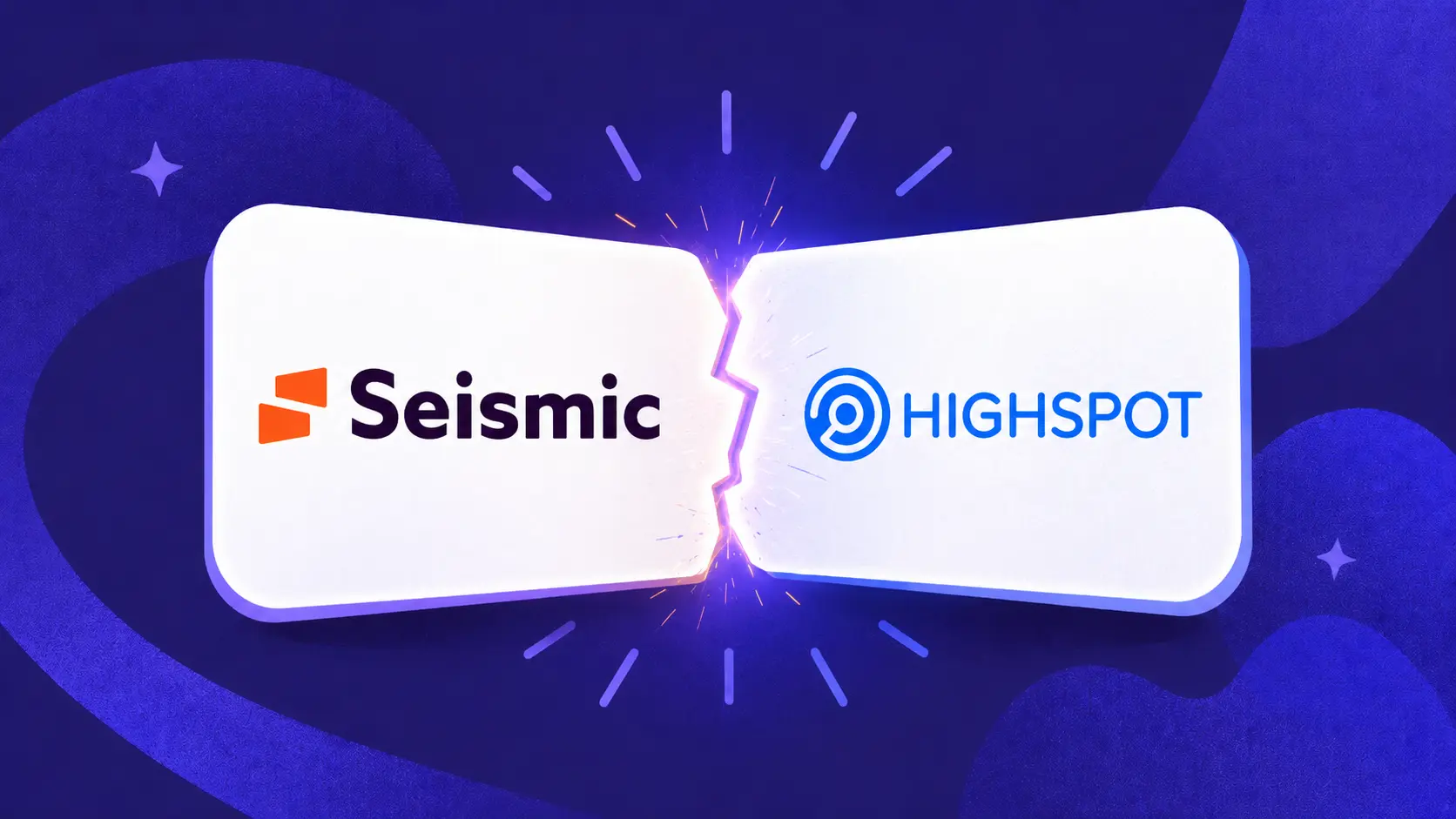
Here's the logic behind the deal, what the category's track record suggests will happen next, and the question worth asking before you renew.
On February 12, 2026, the two largest independent sales enablement platforms agreed to become one.
Seismic and Highspot signed a definitive merger agreement, and once it clears regulatory review, the combined company will operate under the Seismic name.
The press releases called it a merger of two leaders, but the org chart calls it Seismic absorbing Highspot. The merged company will be led by Seismic CEO Rob Tarkoff, with Highspot founder Robert Wahbe joining the board. Permira, Seismic's backer since 2020, stays the controlling shareholder. Until the deal closes, both platforms keep running on their own.
If you run enablement at a company on one of these platforms, you care less about who runs the combined entity and more about what happens to the tool your team depends on.
The big question is: while these two legacy platforms get stitched together, how much of the cleanup will end up on your desk?
Why the merger makes sense on paper
Let’s start with the case for the deal because it's a strong one.
Seismic and Highspot were both built on large amounts of venture capital raised when money was cheap. Seismic has taken in more than $738M over its life. Highspot, more than $654M.
At that scale, the investors backing them are pointed toward one outcome: an IPO that requires both real scale and durable profitability.
Seismic reported its first full profitable fiscal year in FY25. Combining with its closest rival moves that story forward on several fronts. It ends the most expensive competition either company has faced and cuts a chunk of duplicated costs. And it folds two large revenue lines into one number that's easier to take public.
(Not to mention that these companies are finally facing some true competition in the form of up-and-coming AI-first companies…)
GeekWire noted the deal effectively places Highspot under Seismic's leadership and brand. For two companies that spent a decade fighting over the same enterprise accounts, consolidating is a rational financial move.
Of course, that says nothing about the impact on their customers.
What a merger does to a product roadmap
Two enablement platforms this large don't merge on paper. They merge through engineering and by consolidating org charts.
Highspot runs its AI on the Nexus engine. Seismic runs its own branded Aura. They have different content models and learning architectures (Seismic's LMS came from its Lessonly acquisition), plus years of divergent product decisions baked into each.
Reconciling all of that into one platform takes years. During that window, engineering capacity is directed toward integration rather than new customer problems.
Analysts flagged the integration risk within days. Aragon Research, broadly positive on the deal, still named the core technical challenge as fusing Highspot's Nexus engine with Seismic's platform. That work slows the roadmap down.
If you spent the last two years building workflows around one platform's content taxonomy and finally getting your reps to adopt it, a merger turns your time investment into migration exposure.
Seismic has run this play before
The most useful precedent for what comes next is Seismic’s history itself.
Seismic assembled its suite through acquisitions: SAVO in 2018, the Lessonly LMS for roughly $170M in 2021, and Percolate and Grapevine6 along the way.
The recurring critique in customer reviews is the predictable result: a platform that can feel stitched together, with uneven experiences and siloed data across modules that started life as separate products.
It also fits a pattern that's been running across this category for years.
Bigtincan rolled up ClearSlide and then Brainshark in 2020 and 2021. In 2025, Vector Capital took Bigtincan private and folded it into Showpad, with the combined company keeping the Showpad name and a new outside CEO. A team that bought Brainshark in 2021 could have seen the tool they use pulled out from under them three times.
The common thread is private equity. Permira controls the Seismic-Highspot entity. Vector controls Showpad. The math behind these deals favors margin and consolidation—less favorable for customers waiting on specific product gaps.
The combined company is built to go upmarket
Both companies already sell mainly to large enterprises. Together, they will concentrate on where the combined revenue and cost savings are: the biggest accounts.
For a mid-market enablement team, a larger combined enterprise vendor is unlikely to get cheaper or more attentive to a 60-rep deployment while it spends the next few years serving its largest accounts and merging two codebases.
Their pricing makes that obvious. Neither company publishes rates publicly, but both are six-figure-ACV products.
Vendr's benchmark data puts Highspot's average contract at around $91K per year, with deals ranging from roughly $20K to $175K. Seismic's full-platform deals routinely land in the low- to mid-six figures.
The most consistent complaints in public reviews on Gartner and G2 are about cost, a steep learning curve, the admin load required to run the platform, and features customers pay for but never fully adopt.
We hear the same pattern on our own sales calls. Our prospects have called Seismic "crazy expensive" and described it as stalling mid-demo. Highspot draws the same frustration from the other direction—a capable platform that mostly goes unused, with one team telling us they were "using like 1% of it."
Our Head of Sales, Joey Wright, has spent a lot of time in deals against the incumbents. On a recent Grow & Tell episode, he put their adoption problem plainly:
"The product reflects 10 years of feedback... on these bigger tools that create a lot of dysfunction from things like admin controls, setup, implementation, driving adoption in bigger organizations that's really hard to do when you have an account manager at one of these companies that's getting switched out on you every six months."
In both cases, the tool tends to serve as an internal content and training store while the buyer-facing experience gets neglected, and that gap often starts the search for something else. The merger is pushing more of those evaluations into motion.
What this means for enablement leaders
The merger lands differently depending on where you sit.
If you're already on Seismic or Highspot, you're the one who'll field the "what does this mean for us" questions, and the one who inherits the cleanup if the two platforms eventually become one.
A migration can reset the rep adoption you spent years earning, and the numbers you're measured on won't pause while it happens. None of that means you have to switch. It means the merger is a fair trigger to get four answers before your next renewal:
- Roadmap: What actually ships for your platform over the next 24 months, and what's frozen while the teams integrate?
- Pricing: Where does your renewal fall now that the two product lines and price books have been consolidated?
- Migration: How much re-tagging, re-permissioning, and re-training falls on your team, and who pays for it?
- Account continuity: Who owns your account after close, and how many times is that likely to change while the orgs combine?
If the answers come back vague, that's information too.
If you're buying an enablement platform for the first time, the merger changes the menu rather than your renewal. The two biggest independent platforms are now one, and the field you're choosing from is smaller than it was a year ago.
If Seismic or Highspot is on your shortlist, factor in that you'd be onboarding onto a platform in the middle of a multi-year integration. New mid-market accounts tend to get the least attention during a merger, and the product you sign for this year may be mid-migration by the time you've finished rolling it out.
The buying questions change, too:
- Is this platform sized for a team like mine?
- Am I paying for enterprise overhead I'll never turn on?
- Am I buying a stable roadmap or a transition?
For most mid-market teams, a lighter, AI-native platform like Dock is a much better fit.
Why I'm optimistic about what comes next
I run Dock—a Seismic-Highspot competitor—so I'm biased about where this goes. I think it sets up something good for buyers down the line, even if it doesn't feel that way if you're the one on the platform right now.
When the two largest incumbents spend the next few years heads down on integration, it opens a window for a new generation of enablement companies built on AI from the start.
There are several genuinely exciting ones right now (Dock, Letter AI, GTM Buddy, Spekit, etc.), and after a decade of legacy platforms consolidating, the category needs them.
A company starting today is building AI into its foundation rather than bolting it onto a decade of technical debt. That is why newer players ship faster and why their AI tends to feel like part of the product rather than an add-on.
.png)
Comparing sales enablement platforms?
We broke down the differences between the major sales enablement platforms, including Seismic, Highspot, Showpad, and Dock.
What we're building at Dock
Dock is the bet I’m making on the future of revenue enablement. We're built for the part of the market that Seismic is moving away from: scaling businesses that need a real AI-powered enablement infrastructure without an enterprise governance team to run it.
The difference that matters most is who each platform was built for. Seismic and Highspot were built for the admin—the person managing content libraries and training programs—and it shows. Reps have never loved using them. The recurring knock is that sales teams avoid those platforms, and buyers get nothing from them at all.
Dock flips that. Reps like it because it's easy to find the right content and to work with their buyers in one place. Buyers like it because it helps a champion build the internal case and move the deal forward. The admin still gets the governance and analytics they need—they're just no longer the only ones who benefit.
And because we aren't dragging a legacy stack behind us, we keep shipping. In the past quarter alone, we’ve shipped:
- Dock Courses: our LMS, completing collaboration, content, and learning in one platform.
- Dock Slides: admin-governed presentation templates reps personalize per account.
- AI Agent Builder: build customized AI agents that are grounded in your own deal data.
- Dock MCP: Dock works directly inside Claude, ChatGPT, and Gemini.
You can check out our Product Updates page for what we’ve shipped since writing this.
New product features are fun, but we also know switching platforms mid-contract is a big blocker. For teams leaving Seismic or Highspot, Dock offers contract buyouts to bridge the gap. If that's the situation you're in, we’re happy to talk.
Talk to our sales team, or try Dock for free and see the buyer experience for yourself.


Related Revenue Lab Articles
.webp)



Templates for Sales, Onboarding,
Projects and Portals
Customize and share with clients


