


Sales training has a reinforcement problem. We build courses, track completion, and then reps’ behavior stays exactly the same.
Part of it is the tools. Most sales teams are stuck choosing between an enterprise LMS built for HR compliance (not for a rep preparing for a tough discovery call) and enablement platforms that just add another login for the team.
Part of it is structural. Teams treat training as an event: build a course, push it out, track who completed it. It rarely becomes part of the workflow reps already live in—and a rep who has to open a separate platform to train will find a reason not to.
We built Dock's LMS after hearing this from our customers. They were already using Dock for deal rooms and client portals and didn't want a separate system just for courses.
So we studied the market: how every major platform approaches training, and what the enablement leaders we interviewed on our Grow & Tell podcast say actually changes rep behavior.
This guide is everything we learned. We’ll review the best sales training tools, plus, you'll hear from heads of enablement at Gong, Rippling, Vanta, and Demandbase on what separates training that sticks from training that just gets logged as complete.

TL;DR: Our top picks
The best sales LMS per use case:
- Lightweight sales LMS + train customers in the same platform: Dock
- Enterprise-grade legacy enablement + training: Seismic Learning
- Rep readiness tied to sales methodology: Mindtickle
- Field sales, offline access, physical products: Showpad Coach
- Learning-first enablement suite for regulated industries: Allego
- Dedicated AI roleplay practice: LetterAI or SecondNature
- Enterprise LMS for employees + customers + partners: Docebo or LearnUpon
.png)
What is a sales LMS?
A sales LMS (learning management system) is sales training software that helps revenue teams build, deliver, and track training programs for salespeople.
Also called sales training software or a sales learning platform, it's the infrastructure that supports onboarding new hires, rolling out product knowledge before a launch, certifying reps in a sales methodology, and reinforcing skills over time.
Unlike a general corporate LMS—designed for compliance training and company-wide learning across HR, legal, and operations—a sales training platform is built specifically around the workflows, training materials, and performance metrics that matter to a revenue team.
A typical sales LMS includes features like:
- Courses: Create lessons from video, text, quizzes, and embedded documents
- Learning paths: Sequence courses by role, milestone, or certification requirement
- Quizzes and assessments: Test knowledge retention and gate progression
- Manager review and coaching workflows: Review rep submissions, leave feedback, track sales performance over time
- Certifications: Award credentials on completion, with optional expiry and recertification
- Progress analytics: Track completion rates, quiz scores, and time spent at the rep and team level
- Playbooks: Persistent reference content reps consult during deals, separate from structured courses
- AI roleplay: Practice conversations against AI-simulated buyers with automated scoring
- Mobile learning: Access training materials on the go—critical for field sales teams
Why bother with a dedicated sales LMS?
Revenue teams invest in a dedicated sales training LMS for a few reasons.
1. General-purpose LMSes weren't built for sales
The LMS that your IT or HR team purchased for the whole company was designed to streamline compliance training and company-wide upskilling—not to support a sales team closing deals.
Online learning content gets buried next to security certifications and expense policy updates, and salespeople struggle to find what they need.
A dedicated sales LMS keeps sales-specific content front and center, with CRM integration and coaching workflows that a general platform simply doesn't have.
2. Onboarding ramp time is directly tied to revenue
New sales hires who take four months to reach full productivity have a real business cost.
A well-structured learning platform compresses that ramp time by delivering consistent, repeatable learning experiences—rather than relying on a manager to re-run the same onboarding conversation for every new team member.
The best platforms also track enrollment and completion by cohort, so sales leaders can see exactly where new hires are falling behind before it shows up in their numbers.
3. Ad hoc training doesn't scale
What works for five team members doesn't work for fifty. As sales teams grow, the informal knowledge sharing that characterizes early-stage teams starts to break down.
A structured sales training LMS lets you optimize your training programs for scale—standardizing what good looks like across the team without creating a bottleneck for sales managers.
4. Sales success requires continuous learning, not one-time training
One-time training gets forgotten. The best sales training platforms also support ongoing upskilling by surfacing the right training materials to sales professionals as their roles evolve.
Stacey Justice, VP of GTM Enablement at Gong, said her team uses a mountains, rocks, and pebbles framework to think about ongoing training:
"The mountain is where we really focus on a big skill... But let's say you start at Gong in Q4—that mountain isn't happening right now. So one thing we're doing is taking these big core mountain programs and breaking them into microlearnings that we can use for continuous enablement. When managers sit down and have performance conversations, they can say, 'you're really caving on all those discounts—we need you to go in and actually practice this,' and that content is there in a format that matches what we're driving."
— Stacey Justice, VP of GTM Enablement at Gong | From: How Gong Uses Gong for Sales Enablement
To sum it all up: Sales professionals who receive consistent, well-reinforced training close deals faster, ramp to quota sooner, and retain product knowledge longer than those who rely on ad hoc coaching.
LMS features to know before you compare tools
Sales LMS platforms use a lot of the same vocabulary, but implement these features very differently. Here's what the key terms actually mean—and what to look for in each.
Courses and lesson builders
Courses are the basic unit of any LMS. Most platforms let you build lessons from video, text, quizzes, and embedded documents.
The quality gap shows up in the editor: some tools have drag-and-drop builders that a non-technical enablement manager can use in an afternoon. Others require L&D specialists or significant configuration.
If course creation is going to sit with your enablement team rather than a dedicated L&D function, editor simplicity matters more than feature depth.
Learning paths
Learning paths are sequences of courses or lessons assigned to a learner, typically tied to a role (SDR, AE, CSM) or a milestone (new hire, product launch, methodology certification).
The more sophisticated platforms let you add prerequisites, wait steps between modules, and branching based on quiz results. Simpler platforms treat paths as ordered playlists.
Some tools also support social learning features—forums, peer challenges, and discussion threads—that let salespeople learn from each other alongside structured coursework.
For most mid-market sales teams, a playlist structure is enough—branching paths and social learning add admin complexity that rarely pays off at the team sizes involved.
Playbooks
A playbook is a persistent reference document—the talk track for a specific objection, the checklist for running a discovery call, the competitive positioning against a named competitor.
Salespeople consult playbooks during deals, they complete courses during onboarding.
Many platforms conflate the two, but they serve different jobs. The best setups have both: structured courses for initial learning and always-available playbooks for in-the-moment reference.
SCORM
SCORM (Sharable Content Object Reference Model) is a technical standard that allows training content built in eLearning authoring tools to be imported into any compliant LMS.
For sales teams, SCORM matters most when you're inheriting an existing online learning library or need your LMS to sync with an HR system like Workday.
For teams building training from scratch in a dedicated platform, SCORM compatibility is much less important—most modern sales LMS tools have native builders that don't require it.
Manager review & coaching workflows
Most enterprise-grade platforms let sales managers give or record feedback on rep submissions—a video pitch practice, a written response to an objection scenario—and track sales coaching conversations over time.
This is what separates a proper sales LMS from a completion tracker. If your sales managers are expected to use the system for active coaching, not just tracking, this capability matters a great deal.
Certifications
A certification is a formal credential awarded when a learner completes a defined program, passes a minimum score, and optionally gets manager sign-off.
Some platforms support credentials with expiration dates (so a product cert auto-expires after 12 months and triggers re-certification) and test-out options (so an experienced rep can skip training materials they've already mastered).
But a credential is only as good as what it tests. Justin Driesse, Director of Sales Enablement at Legora, makes the case that real-world validation should be part of any certification:
"To me, you're not truly certified until I see that you can do this with a customer... what does it look like when the bullets are flying? What does it look like when you're dealing with a customer who clearly doesn't want to be there with you? That's way different than preparing something with your manager, where they have four canned questions that every rep tells every other rep about in advance.”
So while certifications are a useful feature, Justin warns that too often we fall into the trap of a “performative cert.”
AI roleplay
AI roleplay provides AI-simulated buyer conversations for rep practice. Better AI roleplay implementations let admins configure buyer personas, objection types, and scoring rubrics aligned with your specific sales methodology.
Scores are generated automatically, so reps get feedback without a manager having to review every session.
The category has exploded overnight: Mindtickle, SecondNature, Seismic, Highspot, Showpad, Gong, Letter AI, GTM Buddy, and more all have their own versions.
5 questions to ask before you evaluate any sales LMS
Because there are so many flavors of LMS, here are a few opinions you should form before you go shopping.
1. Do you already have an org-wide LMS—and do sales reps actually use it?
If your company already runs Workday Learning, Cornerstone, or a similar enterprise LMS, your question should be whether the existing system gets traction with sales.
If your HR-owned LMS sits at 20% completion rates for Sales because it was built for compliance training and feels nothing like the tools reps use in a deal, that's a signal to look elsewhere.
A dedicated sales LMS—or an enablement platform with training built in—keeps sales content front and center, with coaching workflows designed to boost sales performance rather than track checkbox completions.
If the existing LMS gets reasonable adoption, layering a sales-specific tool on top may not be worth the cost or the added complexity.
2. Is training actually the problem? Or is it process?
Before buying an LMS, it's worth asking whether more/better training is really what's missing.
If reps aren't consistently following your sales process, or your process is too cumbersome, they may know it, but you’re not making it easy enough for them to follow at scale.
For example, if reps are struggling with multithreading, sure, a course on stakeholder mapping might help—but giving reps structured deal rooms that show them exactly which contacts to add and surface who's engaged and who's gone dark will probably move the needle faster.
Or, if deals frequently stall after the demo, an AI tool that automatically generates a business case from the call might close more gaps than another product-knowledge certification.
It’s not that training isn’t helpful. It's that process tooling and structured training solve different problems, and a lot of teams’ initial reaction is always to reach for training when what they actually need is consistency in how their reps run deals.
For teams where both gaps exist, the right platform might be one that handles both—training and customer collaboration—without requiring you to stitch together a separate sales training LMS and a separate deal room tool.
3. Do you need to train customers and partners too?
Most sales LMSes—Seismic Learning, Highspot, Mindtickle, Showpad Coach—are built exclusively for internal reps. If you need to run a customer onboarding academy, certify channel partners, or train customers on a product they just bought, your options narrow fast.
General-purpose LMSes like LearnUpon and Docebo handle multi-audience delivery well. Dock handles it differently: by embedding courses directly into the client-facing workspace a customer is already using, so they complete training inside the same portal where they track implementation milestones and communicate with your CS team.
4. Do you need AI roleplay—and does it need to live inside your LMS?
Almost every sales enablement platform now markets AI roleplay as a feature, and a few dedicated tools have built their entire product around it. But whether AI roleplay actually works at scale depends heavily on the team.
After talking to lots of enablement leaders, our take is that AI roleplay is best-suited for onboarding and BDR cold calling—scenarios where reps are newer, the sale is more scripted, and repetition has clear value.
But for more senior reps running complex enterprise deals, the reception to AI role play has been cooler. They'd rather learn through coaching on real call recordings.
The more transactional the sale, the stronger the AI roleplay use case. The more senior and complex the deal, the weaker it gets.
Another caveat: reps who aren't intrinsically motivated will learn how to pass the scenario rather than develop the underlying skill—gaming the rubric rather than internalizing the feedback.
That said, there are some genuinely great examples of AI role play out there. Stacey Justice, VP of GTM Enablement at Gong, describes what makes Gong's AI Trainer stand out from generic prompt-based roleplay tools:
"The biggest game changer within Gong Enable is the ability to actually create content and create these role plays that are connected... Let's say your enterprise team is really struggling with negotiating against procurement professionals. You can build out this negotiation role play, the persona’s going to be procurement. And we're going to use all the insights and data from the calls we've had with procurement professionals where we've done really well... It's not me over in the corner creating a mock scenario that I think is what's happening in the field. It's actually pulling from those conversations they're already having. So the credibility goes up completely."
— Stacey Justice, VP of GTM Enablement at Gong | From: How Gong Uses Gong for Sales Enablement
Sheevaun Thatcher, VP Revenue Enablement at Demandbase, believes AI roleplay is great for reinforcement at all seniority levels:
"I don't care if you're 100 or you're 10. You have to role-play. Because if you don't role-play and you don't practice, it's not going to stick... I think it's the Ebbinghaus curve—after 30 days, they only retain 7% of what you taught them if you don't reinforce. So with these AI role plays and AI coaches, we push everybody through the platform."
— Sheevaun Thatcher, VP Revenue Enablement at Demandbase |From: How Demandbase Runs Enablement
Morgan Kassel, Senior GTM Enablement Manager at Vanta, has a more nuanced take:
"AI is not going to replace human-to-human coaching. I don't think a rep ever wants to be coached by a robot. But AI is an excellent way to detect or diagnose gaps to coach on—it's almost like enablement and a frontline manager's best friend in the background, running analysis... You can give it a handful of calls, and it'll make that diagnosis for you."
— Morgan Kassel, Senior GTM Enablement Manager at Vanta | From: Sales Enablement at Vanta
And it doesn't have to live inside your LMS at all. Gong's AI Trainer builds roleplay scenarios from your organization's call recordings, using the same AI that reviews live calls. If your team already runs Gong, AI roleplay may already be available without a separate module or LMS platform.
5. How are you going to reinforce the training after it's done?
This is the question most LMS evaluations never ask—and it's the reason most training programs fail quietly rather than loudly.
Training is just information relay. It gets forgotten within days without follow-through. Jonas Master, VP Sales Enablement at Rippling, says the real work happens after the training session:
"All the activities after the training—whether it's let's listen to Gong calls, let's find out who's doing this really well, let's make sure there's visibility into dashboards, let's build a library of what good looks like, let's do some individual coaching and arm the managers to be a force multiplier—if you put a lot of the effort on that stuff rather than just the initial origination point, you're going to drive much better results."
— Jonas Master, VP Sales Enablement at Rippling | From: Enablement at Rippling
Ryan Vanshur, VP of GTM Intelligence & AI Solutions at Handle, is even blunter about what happens when reinforcement is absent:
"Enablement to me isn't necessarily training. I realized you can run all the training that you want, but if you don't actually have reinforcement systems and content that people use, it's just really expensive theater."
— Ryan Vanshur, VP of GTM Intelligence & AI Solutions at Handle | From: GTM Enablement at Handle
Before you evaluate any sales training software, answer:
- What's the reinforcement plan?
- Do sales managers have dashboards showing skill gaps by rep?
- Is there a library of what top performers do differently on calls?
- Is knowledge retention tracked beyond course completion—meaning quiz scores over time, not just a green checkmark?
If none of those exist, a new platform won't create them.
One more thing to get right: how you will measure behavior change. Completion rates and course adoption are leading indicators—they tell you training happened, not that it worked.
After you run training, look at lagging indicators:
- Did more deals start to close in the months after?
- Did win rates move?
- Did ramp time shorten?
Tracking training itself is the wrong north star. Always track the behavior that training was meant to change.
Okay, let’s move on to tools. They’re split into three main categories.
Sales enablement platforms with LMS
The most popular choice is to go with a sales enablement platform with a built-in LMS, because most enablement teams don’t want to manage multiple tools.
Most tools in this category come with content management, deal rooms, playbooks, and more—so training lives in the same place your team already works day-to-day.
The tradeoff is that none of these platforms is truly LMS-first: if super-deep certification management, compliance tracking, or a sophisticated skills framework is the core requirement, the general-purpose LMSes further down the page may be a better fit.
1. Dock
What it is: Dock is an AI revenue enablement platform where deal rooms, content management, AI agents, and an LMS all live in the same place—covering the full customer journey from first demo through renewal.
Who it's for: B2B revenue teams that want training in the same platform where reps run deals, and CS teams manage customers. It’s a strong fit for teams that also need to train customers and partners.
Why you'll love it:
Dock checks all the standard boxes for a sales LMS, but the platform's true benefit lies in the deal rooms.
Most LMS platforms assume reps will log in specifically to do training. Dock doesn't make that assumption—it puts training inside the platform reps already use every day to run deals and manage customers. If reps are in Dock to check stakeholder engagement, update a mutual action plan, or send an order form, they're already where their training lives.
So training adoption comes from convenience for the rep, not top-down mandates.
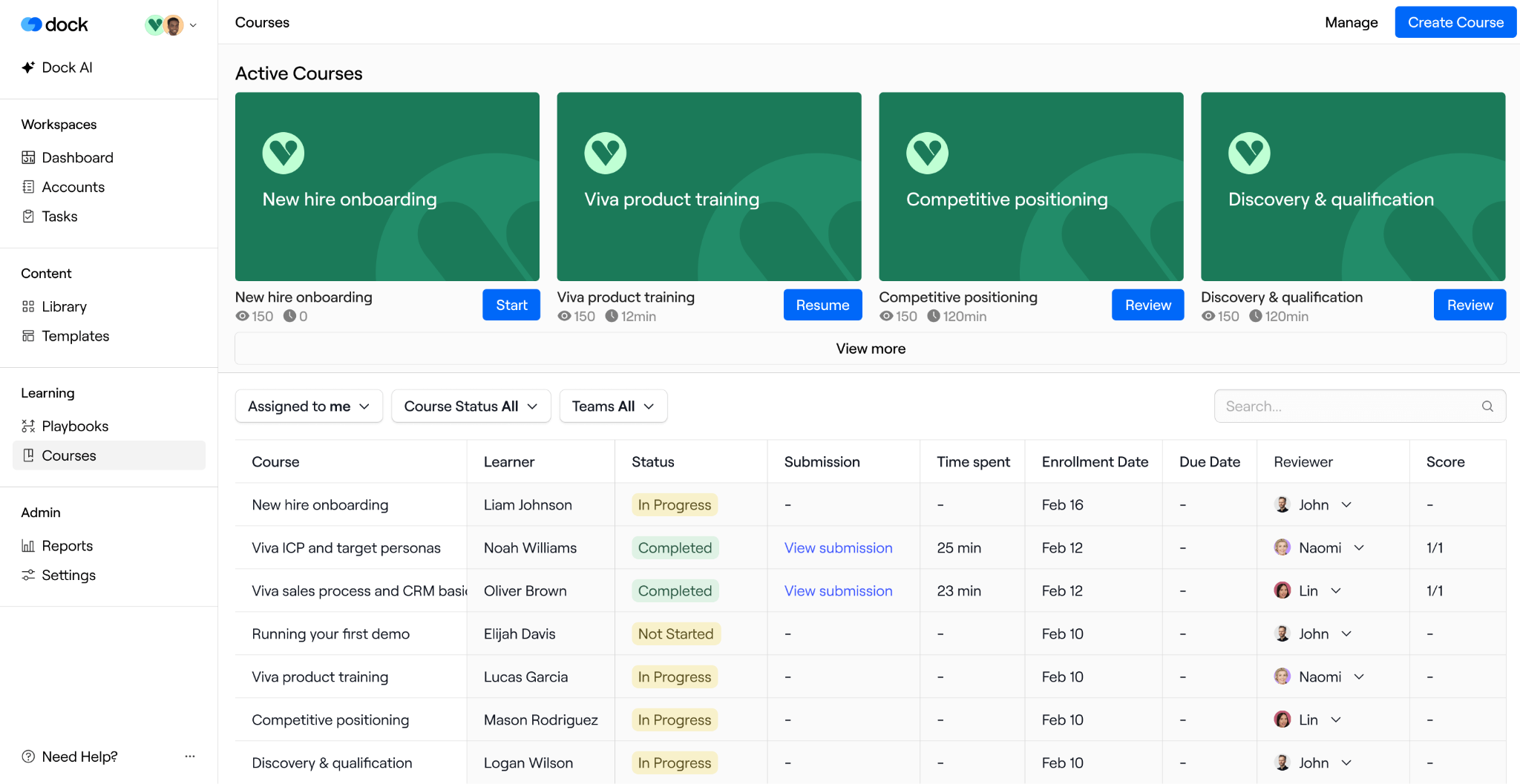
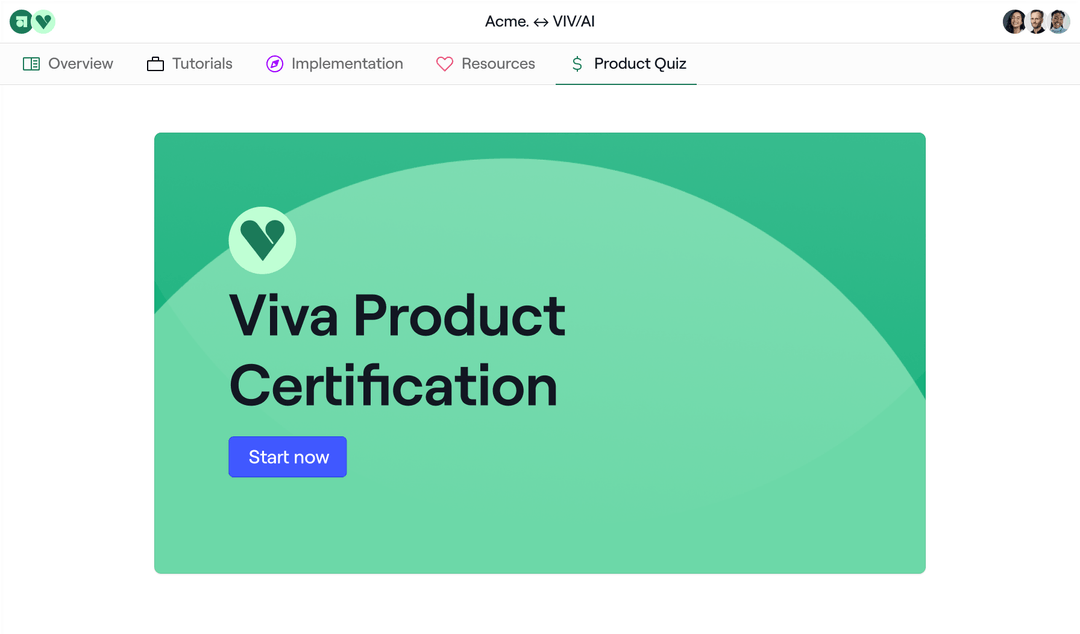
Dock is also the only tool in this category that lets you create courses for customers. Courses can live inside the workspace a customer already uses for implementation—no separate academy platform, no extra login for them either.
Why you might not:
- Lighter than the enterprise platforms. No skills framework, no certification expiry with auto-recertification, no readiness index.
- No AI roleplay. SecondNature, Mindtickle, or Seismic's Aura are better fits if conversation practice is the priority.
- SCORM import only. Dock can't export courses as SCORM files. But that’s not a big deal unless you’re planning to migrate off of Dock.
Key features:
- Courses: sequential lessons, quizzes, flashcards, certifications, SCORM 1.2/2004 import, manager review, progress analytics
- Learning Playbooks: internal knowledge base for onboarding, battlecards, and methodology reference
- Customer and partner training: courses embed into client-facing workspaces
- AI Enablement Agent: real-time answers from your content library, playbooks, and call transcripts
- Full enablement suite: Deal rooms, content management, client onboarding, slides—all in one platform
Pricing: Free plan available. Standard from $350/month (5 seats). Premium from $1,000/month (10 seats). Additional seats at $50/user/month. Enterprise pricing on request—includes Courses, SSO, and custom integrations. No implementation fees.
2. Seismic Learning
What it is: Seismic Learning is the LMS layer of Seismic's enterprise enablement platform, built on the Lessonly acquisition.
Who it's for: Large enterprise teams that want a mature, fully-featured LMS with AI coaching and are willing to invest in the implementation and admin overhead that comes with it.
Why you'll love it:
Seismic Learning is what you get when an LMS company with a decade of customers gets acquired by an enterprise enablement platform with the budget to keep building. For large orgs that need structured training at scale, with everything from course sequencing and spaced reinforcement to AI roleplay and call coaching in one contract, Seismic is the most proven option.
Why you might not:
- Merger risk. Seismic and Highspot announced a merger in February 2026. Roadmap and pricing implications are unresolved—a real consideration in any long-term contract.
- Very expensive. $40K–$180K+/year before implementation. Needs a dedicated admin to run well.
- 4-month average implementation. Not a tool you deploy in a week.
- Internal use only. No customer or partner training.
Key features:
- Full course builder: video, audio, SCORM, podcast-format content; sequenced learning paths; certifications
- Aura Role-play Agent: AI buyer conversations with automated scoring (GA Spring 2025)
- Just-in-time delivery in Salesforce, Slack, and Teams
- Mobile app with offline access
Pricing: Not publicly listed. Expect $40,000–$180,000+/year; enterprise deals commonly exceed $200K. Implementation adds $5,000–$50,000+. 8–12% annual escalations are standard.
3. Highspot
What it is: Highspot is a content-first enterprise sales enablement platform with LMS, AI coaching, conversation intelligence, and deal rooms.
Who it's for: Enterprise teams (500+ employees) where Salesforce is the system of record and content management is as important as training.
Why you'll love it:
Highspot's strength has always been on the content side—helping reps find the right asset at the right moment in a deal, with analytics that show what actually influences outcomes. The LMS sits on top of that foundation, which means training and content live in the same system rather than requiring a separate tool for each.
Why you might not:
- Same merger risk as Seismic. Roadmap decisions are being made for a combined entity.
- $50K+ minimum ACV. Plus implementation costs.
- AI features are increasingly modular. Copilot, Advanced Analytics, and Premium content are paid add-ons.
- Internal use only. Can’t train partners and customers.
Key features:
- LMS: AI-accelerated course authoring, SCORM import, LinkedIn Learning, learning paths, certifications
- AI Role Play: scored against your GTM skill framework
- Nexus AI agents: autonomous training assignment and coaching (enterprise only)
- Copilot: call recording, transcription, real-time guidance, competitor tracking
Pricing: Not publicly listed. Minimum ~$50,000 ACV; average enterprise contract around $90,000/year. Implementation and content migration add $15,000–$70,000+.
4. Showpad Coach
What it is: Showpad Coach is the training and coaching module of Showpad's sales enablement platform, now combined with Bigtincan after their October 2025 merger.
Who it's for: Mid-market to enterprise teams in manufacturing, life sciences, and financial services that need offline mobile access, structured coaching, and content and training in one place.
Why you'll love it:
Showpad Coach is a good fit for industries where sales happens in the field—carrying a tablet into a hospital, presenting equipment at a trade show, demoing a physical product without a reliable internet connection. The Bigtincan merger strengthened exactly those capabilities: offline access, 3D/AR content for physical demos, and mobile-first design.
If you're selling a product someone needs to see and touch, and your reps are often away from a desk, Showpad Coach was built with that context in mind.
Why you might not:
- Merger integration is recent. Showpad declared the Bigtincan integration complete in April 2026, but feature sets are still being rationalized—ask which capabilities come from which codebase before you sign.
- PE ownership creates uncertainty. Vector Capital's incentives differ from those of a growth-stage investor.
- No native clip-to-course workflow. Call recordings have to be manually downloaded and re-uploaded.
- Internal reps only. Can’t train partners and customers.
Key features:
- Full LMS hierarchy with SCORM support and built-in screen recorder
- PitchIQ: async pitch submission with PitchAI auto-scoring
- RolePlayAI: real-time AI conversation practice in four formats
- Offline mobile learning for field teams
Pricing: Not publicly listed. Roughly $25–$45/user/month—most teams pay $50,000–$100,000/year. Annual-only; ~8% price increases at renewal.
5. Mindtickle
What it is: Mindtickle is a revenue enablement platform built around sales readiness—combining LMS, AI coaching, conversation intelligence, and digital sales rooms.
Who it's for: Mid-market to enterprise organizations running structured sales methodologies that want training scores tied directly to deal outcomes, not just completion rates.
Why you'll love it:
Mindtickle has more LMS depth than most platforms in this category—the Readiness Index, adaptive spaced reinforcement, and five distinct practice formats are genuinely built out rather than bolted on. It's a reasonable choice for large organizations that run structured methodologies like MEDDIC or Challenger and want training correlated to CRM outcomes rather than just tracked for completion.
Why you might not:
- Needs lots of configuration. It's a platform that rewards investment: teams that put in the configuration work tend to get real value from it, and teams that don't tend to wonder why they're paying what they're paying.
- Two-way AI roleplay costs extra. The most useful coaching feature is an add-on.
- 36-month contracts preferred. Shorter terms come at a real price premium.
- Internal reps only. Can’t train partners and customers.
Key features:
- Readiness Index: rep scoring and training prescription from call data and deal outcomes
- Five Mission formats: video roleplay, voice-over slideshow, screen share, email evaluation, task evaluation
- Adaptive Spaced Reinforcement: adjusts question frequency per rep
- Two-way AI roleplay: scored against MEDDIC, Challenger, SPIN (add-on)
Pricing: Not publicly listed. Roughly $30–$50/user/month; most mid-market deals land between $30,000–$80,000/year. Implementation adds $3,000–$25,000+.
6. Allego
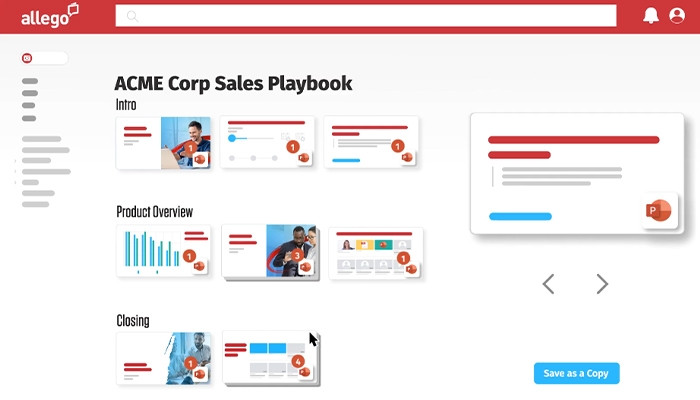
What it is: Allego is a revenue enablement platform spanning learning, content, conversation intelligence, AI coaching, and digital sales rooms—built organically over 12 years rather than assembled through acquisitions.
Who it's for: Mid-market to enterprise teams (300–5,000+ employees) that want learning and coaching depth inside a full enablement suite—especially those in regulated industries like financial services and life sciences, where FINRA/SEC-grade controls are non-negotiable.
Why you'll love it:
Allego is the one platform in this category where learning came first. It started in 2013 as a mobile video-learning tool and built outward from there—the opposite of Seismic and Highspot, which led with content and layered the LMS on top.
If training and coaching are the center of your evaluation, Allego's learning layer is the most mature of the bundled options.
They’ve also gone to great lengths to prove the legitimacy of their AI roleplay. Allego published neuroscience research showing that its Live Dialog Simulator improved seller memory retention by 50% compared with human coaching alone.
Why you might not:
- UI clutter at scale. The most consistent complaint: the interface gets disorganized as content grows, and search is repeatedly flagged as weak for finding specific materials.
- Admin learning curve. Initial setup is complex; onboarding typically runs 4–8 weeks.
- No offline access. Mobile-first, but it needs connectivity—a real gap for field teams where Showpad Coach is stronger.
- Internal reps only. No customer or partner training.
Key features:
- Mobile-first LMS: AI course builder, learning paths, microlearning, ILT, certifications, and spaced reinforcement
- AI Lesson Authoring Agent: builds full courses from existing materials; Skill Maps tie learning programs to revenue outcomes
- Live Dialog Simulator: unscripted video AI roleplay, 32 languages, automated scoring
- Native conversation intelligence (recording, transcription, sentiment, competitor tracking) feeding coaching workflows
- External LMS integrations: Cornerstone, Degreed, Learning Pool
Pricing: Not publicly listed. Vendr median contract ~$49,600/year (range ~$28K–$117K), ~$27K annual minimum. AI features are included in all plans. A 3-year contract is the standard.
AI-focused training platforms
These tools were built with AI as the primary training mechanism—rather than a feature added to an existing LMS.
Most of them can generate a full course from a document, a deck, or a call recording. The better ones can run realistic AI roleplay without requiring weeks of scenario configuration.
You'd choose one of these if speed of content creation is the constraint, if your current enablement platform has weak or no training features, or if AI conversation practice is the specific gap you're trying to close. (Of course, all of the above tools are building deep AI feature stacks too.)
They tend to work best as a complement to existing infrastructure rather than a full replacement, because most don't have the compliance depth, certification mechanics, or enterprise admin controls that L&D teams typically need.
7. Letter AI
What it is: Letter AI is an AI-native enablement platform that generates training courses, playbooks, and coaching simulations from your existing materials.
Who it's for: Mid-market teams that need a full enablement program built fast, without a dedicated L&D function.
Why you'll love it:
Letter AI is for teams that don't have a training program yet—or have one that's embarrassingly out of date—and need to close that gap fast. The typical customer is building training for the first time. If your enablement is currently a Google Drive folder and a Notion doc, Letter AI gets you to something real in days rather than months, with AI doing the heavy lifting on content creation that would otherwise require an instructional designer.
Why you might not:
- No SCORM support. The AI-native architecture skips it.
- Limited track record. Founded in 2023—fast-growing, but fewer enterprise proof points than the incumbents.
- Enterprise security features still maturing.
Key features:
- AI course generation from docs, decks, and call recordings
- AI coaching sims: voice, chat, and email roleplay with custom buyer personas
- Learning paths, knowledge checks, and gamified leaderboards
- Letter Compass: per-deal coaching tied to CRM context
Pricing: Not publicly listed. Positioned for mid-market. Free trial available.
8. SecondNature
What it is: SecondNature is an AI sales roleplay platform—a dedicated practice layer for rep conversation skills, with its own LMS and SCORM export for teams that already run a different system.
Who it's for: Sales teams where rep conversation skills are the primary gap. Also useful as a roleplay layer on top of a general-purpose LMS without practice capabilities.
Why you'll love it:
SecondNature is for teams that have decided AI roleplay is worth taking seriously—and want a tool built specifically for that job rather than a feature bundled into something else. It offers more practice formats, more languages, and faster scenario creation than any LMS-bundled roleplay tool. It's also the only platform on this list that can plug into an existing enterprise LMS via SCORM export, which makes it viable for organizations locked into Workday or Cornerstone but wanting to add a real practice layer on top.
Why you might not:
- One thing only. No content management, deal rooms, or post-sale features—you'll need companion tools.
- Standalone case is shrinking. AI roleplay is now bundled into Mindtickle, Highspot, Seismic, and Gong.
- Culture-dependent. Only works if reps actually practice.
Key features:
- Five roleplay formats: live AI voice/text, webcam pitch, slide presentation, product demo, scripted call
- AI scenario generation from prompts, uploaded docs, or three-URL input
- 27 languages with auto-adaptation
- SCORM export to external LMS
- LMS layer: course builder, learning paths, certifications, leaderboards
Pricing: Not publicly listed. Community sources suggest $30–40/user/month. Free trial available.
9. GTM Buddy
What it is: GTM Buddy is an AI revenue activation platform that combines a content co-pilot, an LMS with adaptive spaced reinforcement, AI roleplay, and a digital sales room—one of the few in this category that publishes pricing.
Who it's for: Mid-market B2B SaaS teams that want content guidance, training, and deal rooms in one place without a six-figure contract.
Why you'll love it:
GTM Buddy is worth considering if you want something close to the enterprise platforms in scope but without the enterprise price tag. It covers more ground than most tools at this price point—content co-pilot, LMS, roleplay, and deal rooms—and unlike most competitors, you can get a real sense of what it costs before talking to anyone.
Why you might not:
- Newer LMS. Depth hasn't caught up with tools that have been LMS-first for years.
- Nucleus agentic layer still in beta. Auto-enrolling reps from call analysis isn't GA yet.
Key features:
- Ask Buddy: AI co-pilot in Salesforce, Gmail, and Chrome
- LMS: AI-assisted course creation, adaptive spaced reinforcement, progress gating
- AI Roleplay: 200+ scenarios across seven stakeholder types
Pricing: Starter ~$49/user/month (publicly listed). Growth and Enterprise on request. Free trial available.
General-purpose LMSes
Most generic LMSes are built for L&D and HR as the primary admin—not for enablement leaders. Most sales teams only end up with one of these because L&D made the purchasing decision.
However, not all hope is lost. These platforms handle more complex training use cases like compliance certification, multi-audience delivery, SCORM content, and tend to have great reporting capabilities.
But they don't have sales-specific things like coaching workflows, AI roleplay, readiness scoring, or anything tied to quota attainment.
10. Docebo
What it is: Docebo is an enterprise-scale LMS for organizations managing training across employees, customers, and partners from one platform.
Who it's for: Enterprise L&D teams (typically 250+ users) that need multi-audience delivery, compliance tracking, and Salesforce/Teams integration at scale.
Why you'll love it:
Docebo makes the most sense when L&D owns the tooling and the requirement is a single system for everyone—compliance training for HR, product training for sales, onboarding for customers, certification for partners—all with separate, branded portals from a single back end.
It's not built for revenue leaders, but for organizations that need training infrastructure across the whole company. Of the three general-purpose platforms here, it's the deeper and more configurable one—with more AI, more skills tooling, and more reporting—which is also why it needs an L&D team with the time to run it well.
Why you might not:
- No sales-specific coaching. No AI roleplay, no readiness scoring, no coaching tied to call data.
- Too much for smaller teams. Under 200 users, you're paying for features you won't use.
Key features:
- SCORM/xAPI, learning paths, certifications, ILT management, gamification
- Multi-audience portals: separate branding for employees, customers, and partners
- AI Creator and Harmony for content generation and admin automation
- Native Salesforce and Teams integration; mobile app
Pricing: Not publicly listed. Roughly $7–10/user/month. Minimum 250 users.
11. LearnUpon
What it is: LearnUpon is a cloud-based LMS built to manage multiple training audiences—employees, customers, and channel partners—from a single platform, with separate branded portals for each.
Who it's for: Organizations that need to give employees, customers, and partners completely different learning experiences without managing separate systems. Good fit for software companies with a customer academy or franchise networks with partner training programs.
Why you'll love it:
LearnUpon does the same multi-audience job as Docebo—employees, customers, and channel partners, each in their own branded portal from a single backend—but with far less weight.
Where Docebo is a deep, highly configurable platform that rewards a dedicated L&D function, LearnUpon is the more focused, faster-to-run option: it nails the extended-enterprise use case without the module sprawl, configuration, and admin overhead.
If multi-audience training is the whole job and you don't have an L&D ops team to wrangle a heavier system, LearnUpon gets you there with a gentler setup.
Why you might not:
- No sales-specific features. Clean SCORM delivery and analytics—but nothing a revenue leader would call sales-specific.
- Less depth than Docebo. For the largest or most complex programs—deep skills frameworks, heavy configuration, the newest AI tooling—Docebo has more headroom.
- Minimum scale. Below 150–200 users, per-user cost makes simpler tools more sensible.
Key features:
- Multi-portal architecture: separate branded portals from one admin back end
- SCORM/xAPI, learning paths, certifications, gamification, eCommerce
- Learning Journeys (Mar 2025): adaptive training automation
- LearnUpon Anywhere: embed courses into your own platform
Pricing: Not publicly listed. Roughly ~$6–9/user/month. Annual contracts typically start at $10–15K.
12. TalentLMS
What it is: TalentLMS is a fast, affordable LMS for small to mid-sized businesses that need to launch training without heavy IT support or a long setup process.
Who it's for: SMBs and startups under ~500 employees that need to go from nothing to running training in days.
Why you'll love it:
If Docebo is the enterprise heavyweight and LearnUpon the focused multi-audience platform, TalentLMS is the entry point—the smallest, cheapest, and most self-serve of the three.
TalentLMS is the training platform you choose when you don't have an L&D function, don't have months to implement something, and don't want to talk to a sales rep before knowing what it costs. The feature-depth tradeoff is significant—but for a team that currently has no training program at all, it gets you somewhere real in a short amount of time.
Why you might not:
- No sales-specific features. No AI roleplay, no methodology enforcement, no coaching tied to call data.
- Teams outgrow it. Complex multi-audience training and adaptive paths at scale hit its limits fast.
Key features:
- TalentCraft: AI course builder from prompts or uploaded material
- SCORM/xAPI, learning paths, certifications, gamification
- Mobile-first; offline learning; Zoom, Salesforce, Slack integrations
Pricing: Starts at ~$109/month. Free trial available.
The best sales LMS is the one your reps actually use
Whether sales training software works has little to do with feature depth. It comes down to one thing: do reps run into training during a normal workday, or do they have to make a special trip to find it?
A rep who opens a deal room template and sees a qualification checklist has already started learning. A rep who has to log into a separate learning portal every Tuesday has already started tuning out.
The other half of this is what happens after. A great LMS with no follow-through is, as Ryan Vanshur put it, “is just really expensive theater.”
The platforms in this guide will help you deliver training. What turns that into results is everything after: the Gong call reviews, managers coaching from dashboards, and the library of what your top performers actually do.
Build that first. Then pick the platform that fits into it.
Sales LMS FAQs
What's the difference between a sales LMS and a generic LMS?
A generic LMS—Docebo, LearnUpon, TalentLMS—is built to deliver and track learning for any audience. Compliance certifications, SCORM content, multilingual delivery, and L&D reporting are what it does well.
A sales LMS is built around the specific problems revenue teams have: onboarding reps to quota in 90 days, certifying product knowledge before a launch, and practicing objection handling before a competitive deal. The coaching layer—manager review, AI roleplay, readiness scoring tied to quota—is what distinguishes it. Most general LMSes don't have it.
What's the difference between a sales LMS and a sales enablement platform?
A sales LMS is the training layer—courses, learning paths, quizzes, certifications, and reinforcement. A sales enablement platform is broader: training is one piece alongside content management, buyer-facing deal rooms, and often conversation intelligence.
Most teams shopping for a "sales LMS" end up evaluating enablement platforms because the LMS is usually just one module within them.
How much does a sales training LMS cost?
It depends heavily on the category, and most enterprise options won't quote a number until you talk to sales.
Enterprise enablement platforms with a built-in LMS—Seismic, Highspot, Mindtickle, Showpad, Allego—run roughly $30,000 to $180,000+ per year. Implementation can run an additional $5,000 to $70,000+. Contracts are often multi-year, and features like AI roleplay or conversation intelligence are frequently paid add-ons.
Dock’s Enterprise plan (which includes the LMS) will have similar annual pricing ($30,000+), but doesn’t require large implementation fees or multi-year contracts.
Other AI-native and mid-market tools—Letter AI, SecondNature, GTM Buddy—are more accessible: GTM Buddy starts at around $49/user/month, SecondNature at around $30–40/user/month. Most offer a free trial.
General-purpose LMSes—Docebo, LearnUpon, TalentLMS—are the cheapest per seat at roughly $6–10/user/month, but they lack the coaching and readiness features a revenue team needs. TalentLMS lists from about $109/month; Docebo and LearnUpon are quote-based with annual minimums around $10,000–$25,000.
Whatever you buy, compare total cost across the full contract term, not the sticker price—implementation, 8–12% annual increases, multi-year lock-ins, and per-feature add-ons routinely push real spend well past the headline rate.
Is AI roleplay worth it for sales training?
AI roleplay is worth it for some teams, oversold for others. AI roleplay is strongest for onboarding and BDR cold-calling—newer reps, more scripted conversations, where repetition has obvious value.
For senior reps running complex enterprise deals, the reception is cooler. They tend to get more from coaching on real call recordings than from a simulated buyer.
The most common complaints against AI roleplay are:
- Reps who aren't motivated will learn to pass the scenario rather than build the skill—gaming the rubric instead of internalizing the feedback.
- Unless the scenarios are created from your actual training data, they may simulate conversations that will never happen anyway.
Can a sales LMS train customers and partners, not just reps?
Most can't. The enterprise sales LMSes—Seismic Learning, Highspot, Mindtickle, Showpad Coach, Allego—are built for internal reps only. If you need to certify channel partners or run a customer academy, those options rule themselves out fast.
For external training, you've got two routes. General-purpose LMSes like Docebo and LearnUpon handle multiple audiences well, with separate branded portals for employees, customers, and partners.
Dock takes a different approach: it embeds courses directly into the client-facing workspace a customer already uses for onboarding, so they complete training in the same place they track implementation and talk to your CS team—no separate academy to log into.
How do you measure whether sales training actually worked?
Completion rates and course adoption are leading indicators—they tell you training happened, not that it changed anything. They're easy to track, which is exactly why most programs stop there.
The real test is in the lagging indicators: did win rates move, did ramp time shorten, did more deals close in the months after?
Tie the training to a behavior you can see in the numbers, then watch that number—not the green completion checkmark. And measurement only works with reinforcement behind it; a single training event with no follow-through won't move a lagging metric, no matter how you track it.
What's the best LMS for sales onboarding?
If onboarding is mostly delivering content—product docs, recorded demos, company overview—any LMS works. If it includes practicing conversations, getting certified on your methodology, and measuring time-to-first-deal, you want a sales-specific platform.
For onboarding that includes coaching, Mindtickle and Seismic Learning are the deepest. For teams that also need to onboard customers, Dock handles both in the same platform.
Does Dock have an LMS?
Yes. Dock Courses launched in March 2026. They include sequential lessons, quizzes, flashcards, certifications, SCORM import (1.2 and 2004), manager review, and progress tracking.
Dock’s LMS is lighter than Seismic or Mindtickle—no certification expiry mechanics, no readiness index, and no SCORM export. But with Dock, training lives in the same platform where reps run deals, and CS teams manage customers. There’s no separate tool to log into, no dedicated admin to maintain it.
Dock courses can also be embedded in client workspaces for customer and partner training.


Related Revenue Lab Articles


.webp)
Templates for Sales, Onboarding,
Projects and Portals
Customize and share with clients


